Maine Coon Aggression: Why the Gentle Giant Bites#
The Maine Coon is famous for being a “Gentle Giant.” So, why is your cat biting your hand when you pet him? Why did he just hiss at the window?
Aggression in Maine Coons is terrifying because of their size. A 5lb aggressive cat is a problem; a 20lb aggressive cat is a hospital visit. However, 99% of “aggression” isn’t malice—it is miscommunication. Cats do not attack for no reason. They give warnings. We just tend to ignore them.
Here are the three most common types of aggression in Maine Coons and how to fix them.
1. Overstimulation (Petting Aggression)#
The Scenario: You are petting your cat. He is purring. Suddenly, he grabs your hand, bites, and bunny-kicks you. The Cause: You crossed the threshold. Cats have a limit on how much tactile stimulation they can handle. It builds up like static electricity. When it becomes too much, it turns from pleasure to pain/annoyance instantly.
The Warning Signs (The “Body Language Decoder”)#
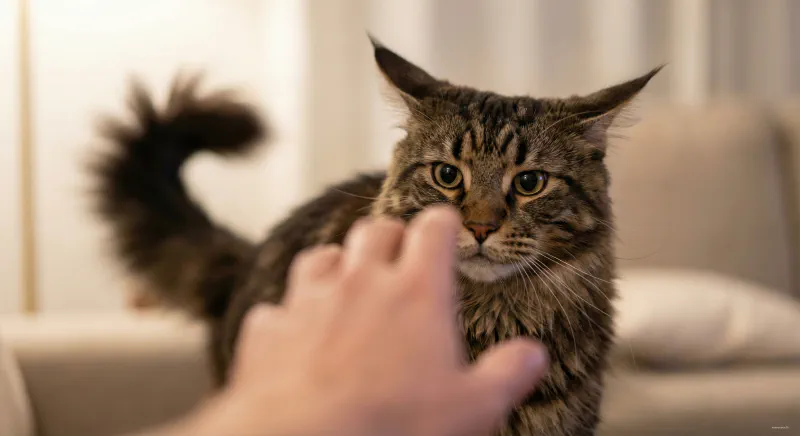
You missed the signs before the bite. Watch for:
- The Tail: If the tip starts twitching or thumping, STOP.
- The Skin: If the skin on their back ripples (twitching), STOP.
- The Ears: If they turn sideways (“Airplane Mode”) or back, STOP.
- The Eyes: Dilated pupils indicate high arousal.
The Fix#
- Stop Early: Pet for 30 seconds, then stop. Let them ask for more.
- Avoid Zones: Most cats hate belly rubs and tail touching. Stick to the head and chin.
- Don’t Punish: Never hit a cat for this. They warned you; you didn’t listen.
2. Redirected Aggression (The Window War)#
The Scenario: Your cat is looking out the window at a stray cat. You walk up to pet him. He spins around and viciously attacks you. The Cause: He wanted to kill the stray cat, but he couldn’t reach it. You were the closest thing he could reach. He didn’t even know it was you; he was in “fight mode.”
The Fix#
- The Lock Down: If your cat is agitated at a window (puffing up, growling), do not touch them.
- Break the Line of Sight: Close the blinds or throw a blanket over the window (from a distance).
- Time Out: It takes a cat 30–60 minutes to calm down from an adrenaline spike. Leave them alone in the room.
3. Play Aggression (The Hunter)#
The Scenario: You are walking down the hall. Your Maine Coon jumps out from behind a door and attacks your ankles. The Cause: Boredom. Maine Coons are hunters. If they have no toys to hunt, they will hunt you. This is common in single cats left alone all day.
The Fix#
- Tire Them Out: You need to play with them before they attack. Use a wand toy (Da Bird) for 15 minutes a day until they are panting.
- No Hands: Never wrestle with your hands.
- Get a Buddy: Sometimes, the best fix for a bored Maine Coon is a second cat to wrestle with.
When to See a Vet (Pain Aggression)#
If a normally sweet cat becomes aggressive suddenly (overnight), it is almost always pain.
- Dental Disease: Stomatitis causes agonizing mouth pain.
- Arthritis: If you touch their hips and they hiss, check for Hip Dysplasia.
- UTI: Bladder pain makes them lash out.
Conclusion#
A Maine Coon is not a stuffed animal. They are sentient predators with boundaries. Respect their body language, provide an outlet for their energy, and rule out pain. If you listen to the whisper (the tail twitch), you won’t have to deal with the scream (the bite).
Resources & Further Reading#
- Cornell Feline Health Center: Feline Aggression Toward People.
- IAABC: Cat Behavior Consultant Directory (for severe cases).
- Jackson Galaxy: The “Cat Daddy” techniques for aggression.