Paw Preference: Is Your Maine Coon Left or Right-Pawed?#
We tend to think of “handedness” as a human trait. You are right-handed, or left-handed (or ambidextrous). But did you know your Maine Coon is the same?
Scientists have discovered that cats show “lateralization”—a preference for using one side of their body over the other for complex tasks.
Why does this matter? Research suggests that paw preference is linked to personality. Left-pawed cats tend to be more anxious and reactive, while right-pawed cats are often more confident and friendly.
Since Maine Coons are known for their confident, “dog-like” personalities, are they mostly righties? Or do we have a lot of creative lefties? Here is how to test your giant at home.
The Gender Split#
One of the strangest findings in feline research is that paw preference is often linked to gender.
- Males are significantly more likely to be Left-Pawed (Southpaws).
- Females are significantly more likely to be Right-Pawed.
Since male Maine Coons are the massive, goofy giants of the breed, many owners assume they are “right-brained,” but the data suggests they lead with their left!
The Test: How to Check Your Cat#
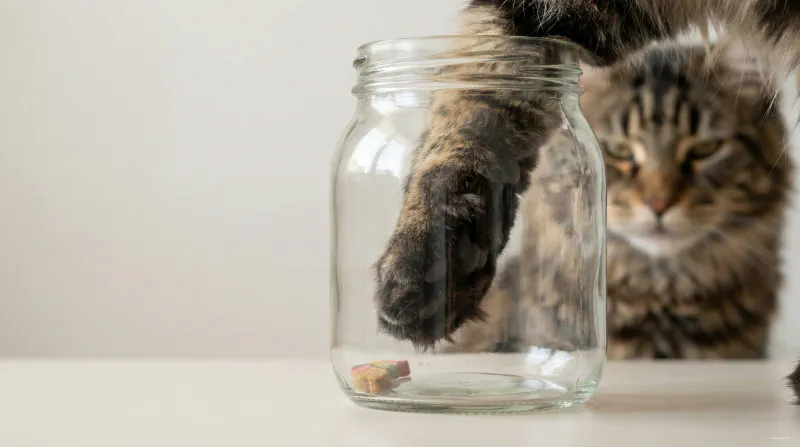
You cannot just watch them walk. Walking is an automatic gait. You need to give them a task that requires dexterity and thought.
The “Food Reach” Test:
- Get a clear glass or a narrow jar that is wide enough for a paw, but too narrow for their head.
- Put a high-value treat (tuna or chicken) inside the glass.
- Place it in front of your cat.
- Watch closely: Which paw do they put in first to fish out the treat?
Repeat this 10-20 times over a few days. If they use the same paw 70% of the time, that is their dominant paw.
The “Step Down” Test: When your cat walks down the stairs or climbs down from a cat tree, watch which foot leads the descent. This is harder to track but is a good secondary indicator.
Interpreting the Results#
- Right-Pawed: Often associated with the left hemisphere of the brain, which processes positive emotions and routine. These cats may be calmer and more confident.
- Left-Pawed: Associated with the right hemisphere, which processes fear and flight responses. These cats might be more jumpy or aggressive when threatened.
- Ambidextrous: Some cats use both. Interestingly, studies show ambidextrous cats are often the most susceptible to anxiety because they lack strong lateralization.
Does it Change Training?#
Knowing your cat’s paw preference can actually help with trick training. If you are teaching “High Five” or “Shake,” ask for their dominant paw. They will learn faster because the motor connection is stronger.
Try the test on your Maine Coon tonight. You might be surprised to find that your gentle giant is a lefty!
Resources & Further Reading#
- Animal Behaviour Journal. (2018). Lateralized behavior in the domestic cat.
- Wells, D. L., & Millsopp, S. (2009). Lateralized behaviour in the domestic cat, Felis silvestris catus.