The Maine Coon Adolescence Guide: Surviving the 6-18 Month ‘Terror Phase’#
There is a specific phone call breeders get. It usually happens when the kitten is around 9 months old. The owner, who was previously sending photos of their “angel,” calls up sounding exhausted and asks, “Is he broken? Did I do something wrong? He just attacked my leg and then knocked over the television.”
Welcome to Adolescence.
If you thought the “terrible twos” were for toddlers, wait until you meet a teenage Maine Coon. Between the ages of 6 months and 18 months, your cat goes through a radical transformation. They are no longer a sleepy, clumsy kitten, but they are not yet a sedate, dignified adult.
They are, effectively, a 15-pound teenager with the energy of a border collie, the impulse control of a gnat, and knives on their feet.
This guide is your survival manual. We are going to cover the physical “awkward phase,” the behavioral rebellion, and exactly how to burn off that nuclear-grade energy without losing your mind (or your security deposit).
The “Lanky” Phase: Physical Awkwardness#
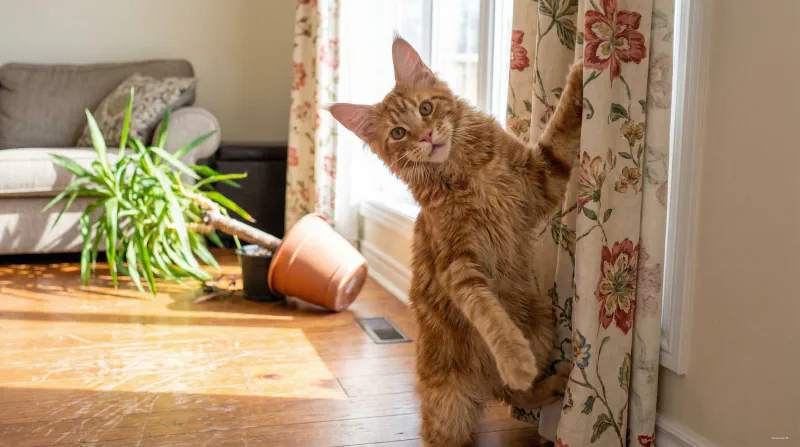
First, let’s talk about how they look. At 4 months, a Maine Coon is a round ball of fluff. At 10 months, they often look like a bicycle made of fur.
This is the “Yak Phase.”
- Disproportionate Growth: Their legs grow faster than their bodies. Their ears look too big for their heads. Their tail looks like a pipe cleaner because the adult plume hasn’t filled in yet.
- Clumsiness: Because they are growing so fast (sometimes 1lb a month), their proprioception (body awareness) lags behind. They misjudge jumps. They slide into walls. They fall off cat trees.
Owner Tip: Do not panic if your cat looks “skinny” or “ugly” during this phase. It is normal. Keep feeding them high-calorie kitten food until they are at least 12-15 months old. They are burning massive amounts of fuel just to grow their bones.
The Behavioral Shift: “Testing Boundaries”#
Just like a human teenager, a Maine Coon adolescent wakes up one day and decides to test the electric fence. Rules that were established months ago are suddenly “optional.”
- Counter Surfing: They know they aren’t allowed on the counter. They do it anyway, while making eye contact.
- The “No” Button: When you say “No,” a kitten might stop. A teenager will often chirp back at you or swat your hand.
- Destructive Chewing: This is the peak time for Pica. Their adult teeth are setting in, their jaws are getting stronger, and they are bored.
The Fix: Consistency, Not Punishment You cannot punish a Maine Coon. They hold grudges. If you spray them with water, they won’t stop the behavior; they will just learn to do it when you aren’t looking (or they will destroy something else in retaliation).
- Redirect: If they are scratching the sofa, physically move them to the sisal post. When they scratch the post, give a high-value treat immediately.
- The “Time Out”: If they are being hyper-destructive or attacking you, calmly pick them up and put them in a boring room (bathroom) for 2 minutes. This removes their “audience.”
Aggression vs. Rough Play: The “Velociraptor” Mode#
This is the biggest complaint I hear. “My cat is biting me.”
Maine Coons are rough-and-tumble cats. In a litter, they wrestle hard. If you have a single kitten, you are the littermate.
When a 12-month-old male Maine Coon wants to play, he plays with the strength of a wild animal. He might ambush your ankles, bite your arm and “bunny kick,” or tackle you from behind a door.
Is it Aggression?
- Play: Ears are forward, claws might be sheathed (or partially out), biting is inhibited (doesn’t break skin deeply), silence or trilling.
- Aggression: Ears pinned back flat, hissing, growling, deep bites that puncture, fur standing up (piloerection).
99% of the time, it is Play Aggression. He is bored out of his mind and wants to wrestle.
How to Stop It:
- Never Use Hands: Never wrestle your cat with your bare hands. You are teaching him that hands are toys. Always use a toy between you and the cat.
- The “Ouch” Method: If teeth touch skin, make a high-pitched “OW!” sound and immediately go limp/walk away. End the game. This mimics what a littermate would do (“You hurt me, I’m not playing anymore”).
- Heavy Work: You need to tire him out physically. A laser pointer isn’t enough; it builds frustration because they can’t “catch” it.
“Heavy Work”: The Cure for Teenagers#
A teenage Maine Coon needs a job. If you don’t give them a job, they will become a demolition expert.
1. Leash Training (The Ultimate Drain) Taking a Maine Coon for a 20-minute “sniffari” outside on a harness burns more mental energy than 2 hours of playing inside. The sensory overload of smells and sounds exhausts them.
2. Clicker Training Teach them to sit, high five, or jump through hoops. Mental exertion tires them out faster than physical exertion. 10 minutes of training equals 30 minutes of running.
3. The “Kill” Session Use a wand toy (like a Da Bird or a RompiCatz) to simulate a hunt. Make the toy fly, hide, and scurry. Let them catch it. Let them “kill” it. Then immediately feed them. This triggers the “Hunt-Eat-Sleep” cycle we discussed in the Zoomies guide.
Conclusion: It Gets Better#
I promise you, this phase ends. Usually, around 2 to 3 years old, the “brain” catches up with the “body.” They settle down. They become the lap cats and gentle giants you see on Instagram.
But right now, you are in the trenches. Your job is not to suppress their energy, but to channel it. Buy bigger scratching posts, stock up on wand toys, and remember: he’s not being bad; he’s just a teenager.
Resources & Further Reading#
- Journal of Veterinary Behavior. (2022). Adolescent behavior in companion cats.
- International Cat Care. (n.d.). Play Aggression in Cats.
- Jackson Galaxy. (2021). The “Raw Cat” Rhythm.