The Genetics of the Red Tabby: Why 80% Are Male#
In the lexicon of Maine Coon breeders, the color “Orange” does not technically exist. The correct terminology is Red, a color determined by a specific genetic mutation that completely replaces the cat’s black pigment (eumelanin) with red pigment (phaeomelanin). While owners love them for their vibrant coats and “ginger” personalities, geneticists find them fascinating for a different reason: Red is the only color in the feline genome that is sex-linked. This unique chromosomal attachment is the reason why the vast majority of red cats are male, and why a female red cat is considered a genetic unicorn by many breeders.
To understand why, we must look at the sex chromosomes. Just like humans, female cats are XX and male cats are XY. The gene responsible for the red color, labeled as the O gene, is carried exclusively on the X chromosome. The Y chromosome, which makes a cat male, carries almost no color information. This creates a statistical imbalance. For a male kitten (XY) to be red, he only needs his single X chromosome to carry the red gene. If his mother passes him a red X, he is a Red Tabby. There is no second chromosome to compete with it. It is a binary switch: he is either Red (O) or Black (o).
For a female kitten (XX) to be red, the math is significantly harder. She must inherit the red gene on both of her X chromosomes. This means she needs a red X from her mother and a red X from her father. If she inherits one red X and one black X, the two colors battle for dominance, resulting in a Tortoiseshell—a black and red patchwork. Therefore, producing a female Red Maine Coon requires a very specific breeding pairing: a Red father and a Red (or Tortoiseshell) mother. Because this combination is statistically less common than random pairings, approximately eighty percent of all red cats born are male.
The “Rufus” Factor: Ginger vs. Mahogany#
Not all Red Maine Coons look the same. Some are a pale, sandy ginger (often called Cream, which is the dilute version), while others are a deep, rich rust color. This variation is not controlled by the O gene itself, but by a set of invisible “boosters” called Rufus Polygenes.
Think of the O gene as the on/off switch for the color red. The Rufus polygenes are the volume knob. A cat with “low Rufus” will appear washed out or yellow. A cat with “high Rufus” will have a coat that borders on dark mahogany or bronze. Show breeders spend decades selecting for high Rufus factors to create the vibrant, deep red coats seen in the show hall. This intensity often takes time to develop; as we discuss in our Kitten Coat Change Guide, a kitten often looks paler at birth and “warms up” as they mature over the first two years.
The “Solid Red” Myth#
One of the most confusing rules in cat genetics is that Solid Red cats do not exist. If you see a black cat, it can be a Solid Black (no stripes). However, the Red gene has a unique property: it bypasses the “Non-Agouti” (solid) gene.
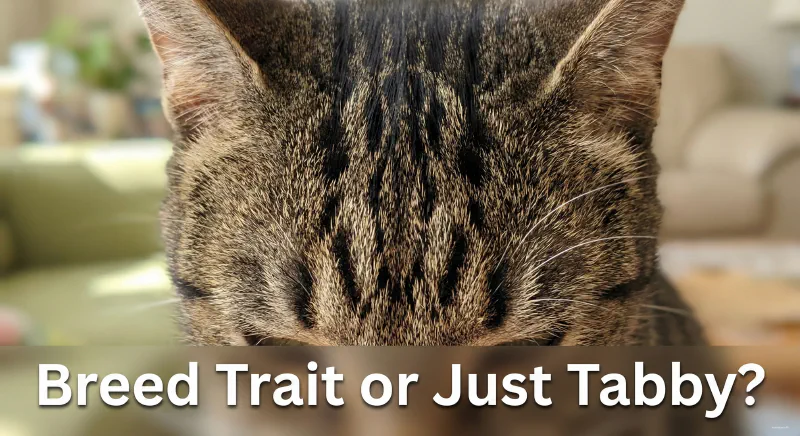
The non-agouti gene is what normally suppresses the tabby pattern, turning a Black Tabby into a Solid Black. But the Red pigment is not affected by this suppressor. Therefore, every single Red Maine Coon is genetically a Tabby. They will all have the classic “M” on their forehead and stripes on their legs. Breeders may register a cat as a “Solid Red” if the stripes are blurry or low-contrast (ticked), but genetically, the pattern is always there. This is why you will never see a Red Maine Coon that is as uniformly solid as a Black or Blue Maine Coon; the ghost stripes will always shimmer through the coat.
Ultimately, the Red Tabby is a masterpiece of X-linked genetics. Whether you have a common male or a rare female, you possess a cat whose color is the result of a specific and dominant mutation that refuses to be hidden—literally and metaphorically.