The Genetic Rainbow: Decoding Maine Coon Colors#
The Maine Coon is a marvel of feline evolution, not just for its size, but for its genetic diversity. Unlike breeds defined by a single color (like the Russian Blue) or a specific pattern (like the Siamese), the Maine Coon’s history as a rugged working cat has preserved a vast palette of potential coat colors.
The Cat Fanciers’ Association (CFA) recognizes nearly every color and pattern combination imaginable, with the exception of “pointed” patterns (color-point), which would indicate hybridization with Siamese lines.
This guide moves beyond simple descriptions to explain the genetics behind the most sought-after colors, helping you identify exactly what kind of “Gentle Giant” you have—or want to find.
1. The Solids: The “Non-Agouti” Cats#
A “Solid” cat is one that has no stripes. Genetically, this occurs when a cat inherits two copies of the recessive non-agouti (a) gene. This gene essentially “switches off” the tabby pattern, flooding the hair shaft with a single uniform pigment.
The Black Maine Coon (“The House Panther”)#
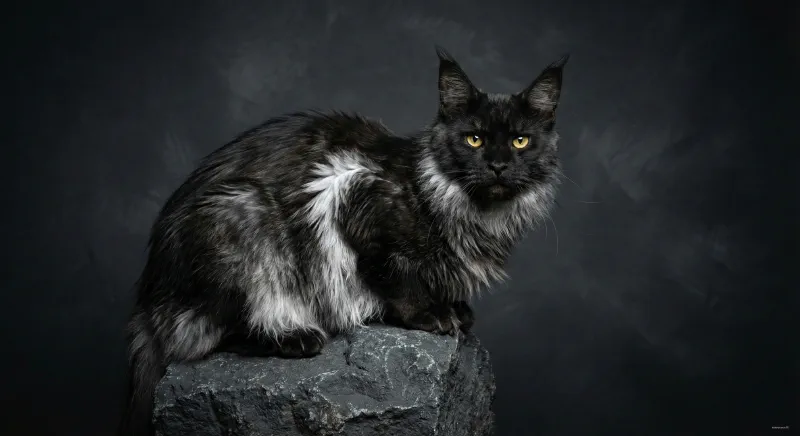
True solid black Maine Coons are breathtakingly dramatic. They are often described as having a “wild” or “mythical” presence.
- The Standard: To be show-quality “Solid Black,” the cat must have black nose leather and black paw pads. If the nose is pink, the cat is genetically a Black Smoke or a very dark Tabby.
- The “Rust” Phenomenon: Owners often panic when their black cat turns reddish-brown in summer. This is not a health issue; it is a chemical reaction where melanin (black pigment) oxidizes in sunlight. It is a sign your cat is enjoying their catio!
The Blue (Grey)#
In the cat fancy, there is no “Grey.” We call it Blue.
- The Genetics: Blue is a dilute form of Black. A specific gene causes the pigment granules to spread out in the hair shaft, reflecting light in a way that appears slate-grey.
- Texture Difference: Interestingly, the “Dilute” gene often affects hair texture. Many breeders and owners report that Blue Maine Coons have a softer, more powdery, and “cottony” coat that requires more frequent grooming to prevent mats.
The White#
- The Genetics: The “White” gene is actually a “masking” gene. It acts like a white sheet thrown over the cat’s true color. Underneath that white fur, the cat is genetically black, red, or tabby, but the white gene prevents any color from expressing.
- Health Note: As noted in our Veterinary Report, white cats with blue eyes carry a higher statistical risk of congenital deafness. Responsible breeders perform BAER (Brainstem Auditory Evoked Response) testing on white kittens before sale.
2. The Tabbies: The “Wild Type” (Agouti)#
The Tabby pattern is the original, ancestral coat of the Maine Coon. It provided essential camouflage in the forests of New England. All tabbies have the distinctive “M” marking on their forehead.
The Brown Classic Tabby#
This is the quintessential Maine Coon.
- The Pattern: “Classic” means the stripes are swirled, creating a bullseye or “oyster” shape on the flank (side) of the cat. They often have a “butterfly” pattern across the shoulders.
- Popularity: This is the most frequently registered color in the CFA.
The Mackerel Tabby#
- The Pattern: Unlike the swirled Classic, the Mackerel has thin, vertical stripes running down the body from the spine, resembling the bones of a fish (hence the name). This pattern looks the most like a wild tiger.
The Red (Orange) Tabby#
- The Genetics: Red is a sex-linked gene carried on the X chromosome. Because males have one X (XY) and females have two (XX), a male only needs one copy of the “Red” gene to be orange. A female needs two.
- The Result: Approximately 80% of Red Tabbies are male.
- Personality Myth: Is the “Ginger Cat Energy” real? While not scientifically proven, surveys of Maine Coon owners consistently rate Red Tabbies as the most affectionate, “Velcro” personalities in the breed.
3. The Smoke & Silver: The “Inhibitor” Gene#
This is the category that captivates the internet. These cats possess the dominant Inhibitor (I) gene, which suppresses pigment at the base of the hair shaft.
The Black Smoke#
- The Effect: The hair shaft is white at the root and black at the tip. When the cat is resting, they look solid black. When they move or the wind blows, the fur parts to reveal flashes of stark white light. It creates a ghostly, ethereal appearance.
- High Contrast: The best examples have a “high smoke” contrast—very short black tips and long white roots.
The Silver Tabby#
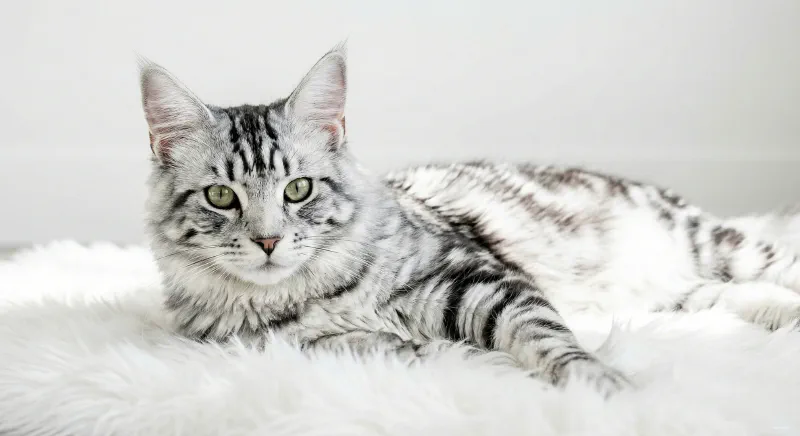
- The Effect: This is a tabby cat where the “background” color (usually brown/tan) has been bleached to pure white by the Inhibitor gene. The black stripes remain jet black.
- The “Whiskas” Look: This creates a stunning high-contrast look (Black on Silver) that is incredibly photogenic.
4. The Tortoiseshell & Calico: The “Painters”#
These patterns are the result of the X-chromosome color linkage we discussed earlier.
- Tortoiseshell (“Tortie”): A random mix of Black and Red patches blended throughout the coat. There is no white.
- Calico: A Tortoiseshell that also has the “White Spotting” gene. This creates distinct patches of solid color (Black, Red) on a white background.
- The “Tortitude”: Veterinary professionals often jokingly warn about “Tortitude”—a perceived increase in feistiness and independence in Tortoiseshell cats.
- Gender: Because this requires two X chromosomes (one carrying Black, one carrying Red), 99.9% of Torties and Calicos are Female. (Rare sterile males occur in 1/3000 births due to Klinefelter syndrome XXY).
5. Rarity & Pricing: What Costs More?#
While color does not affect a cat’s health (except for White/Deafness), it drastically affects demand.
| Color/Pattern | Rarity | Price Premium |
|---|---|---|
| Brown Tabby | Common | Standard |
| Solid Black | Moderate | +10% |
| Black Smoke | High | +25-40% |
| Silver Shaded | Very High | +50% |
| Polydactyl (Any Color) | Moderate | +20% |
Note: A “Rare Color” should never be the primary reason for buying a cat. Health testing (HCM/Hip Dysplasia) is infinitely more valuable than a coat color.
🧬 Summary for Buyers#
When looking for a kitten, do not get too hung up on “marketing names.”
- A “Blue Smoke” is just a Dilute Black Smoke.
- A “Cream Tabby” is just a Dilute Red Tabby.
- A “Torbie” is just a Tortoiseshell with Tabby stripes.
Focus on the Health Screenings first. A healthy Brown Tabby is a far better companion than a sickly Black Smoke.
📚 References#
- The Cat Fanciers’ Association (CFA). Maine Coon Breed Standard: Color Classifications. cfa.org
- Lyons, L. A. (2015). Feline Genetics: Clinical Applications and Genetic Testing. Veterinary Clinics: Small Animal Practice.
- Robinson’s Genetics for Cat Breeders and Veterinarians. (Textbook). Pigment Genetics and the Agouti Locus.
- UC Davis Veterinary Genetics Laboratory. Coat Color Testing & The Inhibitor Gene.