The White Maine Coon: Blue Eyes, Deafness Myths & Care#
In the diverse spectrum of Maine Coon colors, the Solid White stands apart as a creature of ethereal beauty. While the Black Smoke looks like a panther and the Classic Tabby looks like a forest predator, the White Maine Coon resembles a cloud brought to life. There is nothing quite as visually arresting as a fifteen-pound pristine white cat with piercing blue or odd-colored eyes. However, owning a white cat is not merely an aesthetic choice; it is a medical responsibility. The genetic mechanism that creates that snow-white coat carries significant biological baggage, specifically linking the lack of pigment to auditory health and sun sensitivity.
To understand the White Maine Coon, one must first understand that white is not actually a color. Genetically, these cats are masking another color entirely. The Dominant White gene (labeled as ‘W’) acts like a heavy blanket thrown over the cat’s true genetic code. Underneath that white fur, your cat might genetically be a Black Tabby, a Red Smoke, or a Tortoiseshell, but the W gene prevents any of those pigment cells from migrating to the hair follicles. This massive suppression of pigment is what gives them their striking appearance, but it is also what causes the health complications that every prospective owner must understand.
The most pervasive concern regarding white cats is the link to congenital deafness. This is not an old wives’ tale; it is a documented biological phenomenon linked to the W gene. The same stem cells that are responsible for creating pigment in the coat are also responsible for developing the delicate hair cells inside the inner ear. When the W gene aggressively strips pigment to create a white coat—and especially when it strips pigment from the iris to create blue eyes—it can inadvertently starve the inner ear of these critical cells, causing the cochlea to degrade shortly after birth.
This link creates a statistical risk profile that varies by eye color. A white cat with gold or green eyes has a lower risk of deafness, estimated around twenty percent. However, a white cat with two blue eyes has a risk factor jumping to nearly eighty percent. This does not mean the cat is “broken,” but it does mean they have special needs. If you are purchasing a white kitten, particularly a blue-eyed one, you must ask the breeder for proof of a BAER test (Brainstem Auditory Evoked Response). This is the only definitive way to test hearing in a kitten. Buying a white kitten without this test is a gamble that requires you to be prepared for the possibility of a deaf companion who will startle easily and require hand-signal training.
Beyond their hearing, White Maine Coons face a unique environmental threat: the sun. Melanin is nature’s sunscreen, and a white cat has none. The delicate skin on their ear tips and the bridge of their nose is completely unprotected from UV radiation. Just as pale-skinned humans are prone to burning, white cats are highly susceptible to sunburn, which can escalate into Squamous Cell Carcinoma, a form of skin cancer. Owners of white Maine Coons must be vigilant about sun exposure. If your cat enjoys a Catio or sunbathes in a window, you must apply pet-safe sunscreen to their ears or apply UV-blocking film to your windows to prevent cellular damage.
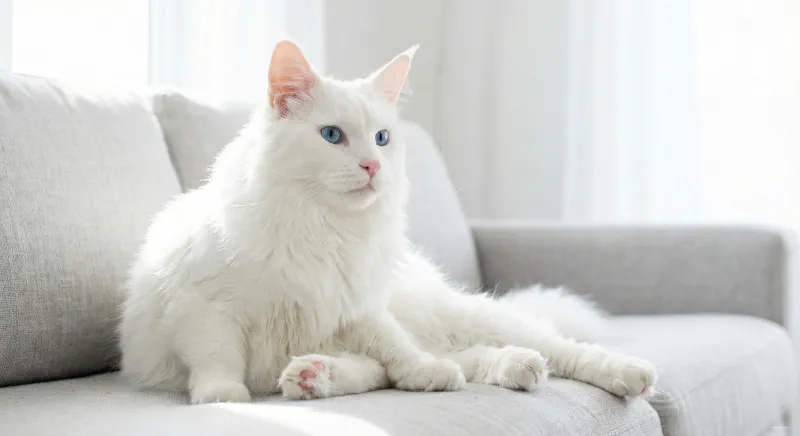
Finally, there is the reality of maintenance. A white coat is unforgiving. Every speck of dust, every drop of eye discharge, and every bit of food is visible. The most common aesthetic battle is tear staining, where the fur under the eyes turns a rusty brown. This is caused by porphyrins in the tears oxidizing in the air. While often harmless, it requires daily cleaning to prevent the fur from becoming permanently stained. Furthermore, their paws can easily become discolored by clay litter or household dust. Owning a white Maine Coon requires a commitment to hygiene that darker cats do not demand, often necessitating a regular Bathing Routine with whitening shampoos to keep them looking like a show cat rather than a grey ghost.
Ultimately, the White Maine Coon is a statement piece that requires a dedicated owner. You are not just brushing fur; you are managing eye stains, monitoring sun exposure, and potentially navigating a silent world with a deaf cat. But for those willing to put in the work, the reward is living with one of the most breathtaking animals in the feline kingdom.
References#
- Louisiana State University. Genetics of Deafness in White Cats.
- Cornell Feline Health Center. Squamous Cell Carcinoma in White Cats.
- TICA. BAER Testing Standards.