European vs. American Maine Coon: Phenotype Wars and Health Realities#
Scroll through Instagram for five minutes under the hashtag #MaineCoon, and you will see two very different animals.
One looks like a sweet, oversized house cat with a gentle expression and a shaggy coat. The other looks like Ron Perlman in full makeup for Beauty and the Beast—massive muzzle, ears that reach the ceiling, and a gaze that looks like it wants to conquer a small village.
Welcome to the “Phenotype War.” This is the battle between the Traditional American Maine Coon and the Extreme European Maine Coon.
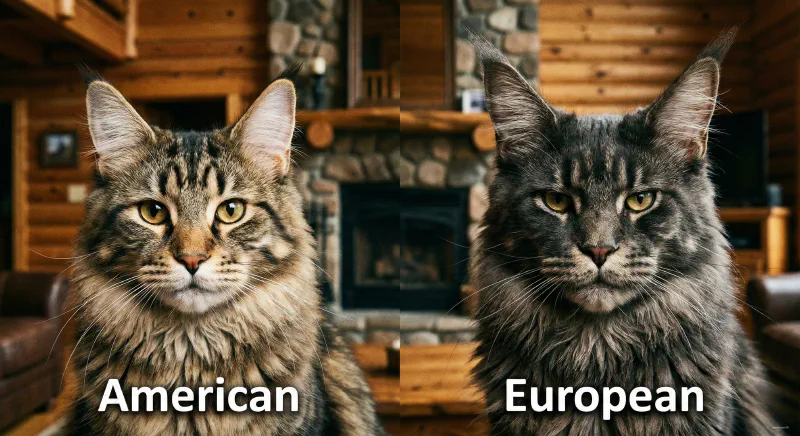
Are they different breeds? No. Are they genetically distinct? Barely. Do they come with different price tags and health risks? Absolutely.
The Origins of the Split#
Historically, the Maine Coon is an American breed. It originated in New England as a working farm cat (see Maine Coon History). The original breed standard, maintained by the Cat Fanciers’ Association (CFA), emphasized a “sweet, open expression” and a functional, rectangular body.
However, in the 1990s and 2000s, breeders in Europe (particularly in Russia, Germany, and Italy) fell in love with the breed’s “wild” aspect. Operating largely under FIFe (Fédération Internationale Féline) and TICA (The International Cat Association) standards, they began selecting for exaggeration.
They wanted bigger ears, bigger boxes (muzzles), and a more feral look. Over 20 years of selective breeding, they created what we now call the “Euro Look.”
Decoding the Look: The “Sweet” vs. The “Feral”#
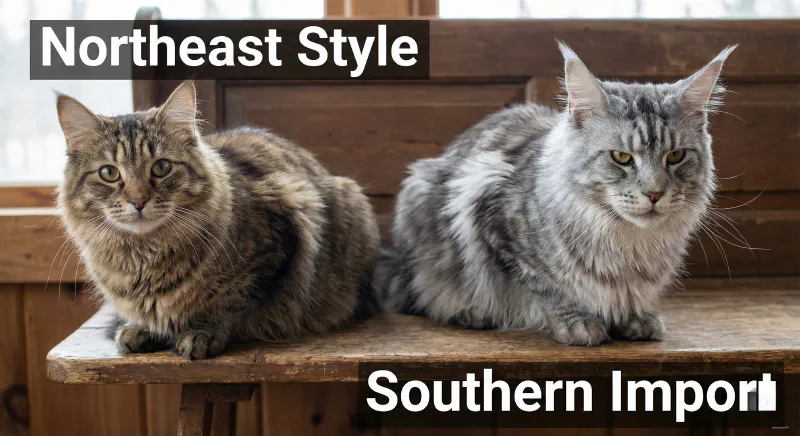
Here is how to tell them apart instantly.
1. The Muzzle (The Box)#
- American: The muzzle is square but softened. It blends gently into the cheekbones. It looks natural, like a barn cat.
- European: The muzzle is deep, prominent, and extremely square. It often looks like a separate block attached to the face. This is often called “The Box.”
2. The Ears (Lynx Tips)#
- American: Ears are large and tufted, but they sit wider on the head. The “Lynx Tips” are moderate.
- European: Ears are tall, upright, and set closer together on top of the head. The tips are often 2-3 inches long, giving the cat a distinct wildcat silhouette.
3. The Eyes#
- American: Rounder, wide-set, with a “sweet” or inquisitive expression.
- European: Almond-shaped, hooded, and deep-set. This creates the signature “Feral Gaze” or “The Maine Coon Glare” that makes them look angry even when they are purring.
Is One Healthier Than the Other?#
This is the controversial part. If you ask an American breeder, they will say the European lines are “hyper-typed” and unhealthy. If you ask a European breeder, they will say the American lines are “inbred” and boring.
Here is the veterinary reality.
The Risk of “Hyper-Typing”#
The European focus on extreme features can lead to structural issues if not managed carefully:
- Entropion: The deep-set, hooded eyes of extreme Euro cats can sometimes cause the eyelids to roll inward, irritating the cornea.
- Dental Issues: The exaggerated jaw size can sometimes lead to misalignment of the teeth (malocclusion).
The Inbreeding Coefficient (COI)#
Ironically, because the European lines were built by importing cats from the US and then breeding them heavily, some European lines actually have lower genetic diversity (higher COI) than American foundation lines. However, many European breeders are meticulous about outcrossing to keep the gene pool healthy.
The Verdict: Neither is inherently healthier. Health depends on the specific breeder testing for HCM, SMA, and PK Def. A “Euro” breeder who doesn’t scan hearts is a ticking time bomb, no matter how cool the cat looks.
Which One Should You Buy?#
This comes down to personal preference, but be prepared for a price difference.
- The American Look: Usually priced between $2,000 - $3,000. These cats are classic, timeless, and generally have the “golden retriever” personality the breed is famous for.
- The European Look: Often priced between $3,500 - $5,000+. You are paying for the “wow factor.” These cats are viral sensations.
Amelia’s Advice: Be very careful with breeders advertising “XXL Euro Giants.” Often, these breeders are prioritizing size over heart health. A 25lb cat with a bad heart is a tragedy waiting to happen. Always ask to see the parents’ recent echocardiograms (not just genetic tests).
Conclusion#
Whether you prefer the gentle, sweet look of the American traditionalist or the fierce, lion-like visage of the European extremist, you are getting a Maine Coon under the hood. They both chirp, they both play in water, and they both want to be involved in every aspect of your life.
Just remember: You don’t pet the phenotype; you pet the cat. Choose the kitten whose personality matches your home, not just the one that looks coolest on TikTok.
References#
- CFA Breed Council. Maine Coon Breed Standard: The Sweet Expression.
- FIFe Breed Standard. Maine Coon (MCO) - The Wild Look.
- Journal of Heredity. (2008). “Phenotypic variation in the Maine Coon cat.”
- Veterinary Ophthalmology. (2015). “Entropion in deep-set eyed cat breeds.”
- PawPeds. Inbreeding Coefficients in European vs American Lines.
- TICA. Maine Coon Seminar: Balancing Type and Health.