Maine Coon vs. Siberian: The Ultimate Battle of the Forest Giants#
It was a rainy Tuesday afternoon when a client walked into the clinic with a massive, dripping wet carrier. Inside was “Yuri,” a 18-pound fluff-ball that she swore was a Maine Coon. “Look at the ear tufts, Amelia!” she insisted. “He’s huge!”
I took one look at Yuri’s round, barrel-shaped chest and his sweet, curved profile and shook my head. “That,” I said, “is a tank, not a brick. You have a Siberian.”
This is the most common case of mistaken identity in the cat world. To the untrained eye, the Maine Coon and the Siberian look like long-lost cousins. They are both large, fluffy “Forest Cats” that evolved in freezing climates (New England vs. Russia) to be rugged survivors.
But genetically? They are practically strangers.
If you are torn between these two giants, this guide isn’t just a beauty contest. We are digging into the chromosomal differences, the “hypoallergenic” reality check, and the very different personalities hiding under all that fur.
The “Convergent Evolution” Myth#
Why do they look so similar if they aren’t related? Biologists call this Convergent Evolution.
Think of it like a shark and a dolphin. One is a fish, one is a mammal, but they both have fins and streamlined bodies because they live in the ocean. Similarly, the Maine Coon and the Siberian evolved in places with harsh, snowy winters.
- The Maine Coon (The American Barn Cat): Evolved in the Northeastern US. Their coat is shaggy and uneven to shed water and snow. They are hunters designed to keep grain silos mouse-free.
- The Siberian (The Russian Wild Cat): A “Landrace” breed that evolved naturally in the forests of Siberia (specifically the Taiga) for over 1,000 years. Their coat is triple-layered and incredibly dense to survive temperatures dropping to -50°F.
The Bottom Line: The Maine Coon is a “refined” rugged breed. The Siberian is a “ancient” natural breed that has only recently been domesticated and standardized (since the 1990s).
Physical Differences: The “Rectangle” vs. The “Barrel”#
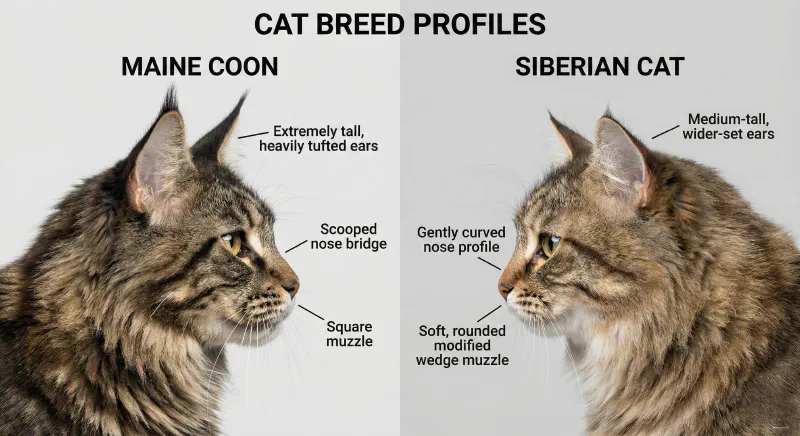
If you put a Maine Coon and a Siberian side-by-side, the silhouette gives them away instantly.
1. The Body Shape#
- Maine Coon: The breed standard calls for a Rectangular body. They are long, tall, and athletic. When you pick them up, they feel like a long, stretchy slinky of muscle. They are the basketball players of the cat world.
- Siberian: The standard calls for a Barrel shape. They are stockier, rounder, and heavier in the midsection. They have substantial bone density and feel like a solid weight in your arms. They are the wrestlers or linebackers.
2. The Head Structure (The Muzzle Test)#
This is my favorite trick for identification.
- Maine Coon: Square muzzle. If you look at a Maine Coon straight on, their muzzle should look like a box. Their ears sit high and upright (like a rabbit).
- Siberian: Rounded muzzle. Their head is a “modified wedge” with rounded contours. Their ears are set wider apart and are more rounded at the tips.
Amelia’s Note: If the cat looks like it’s glaring at you with a serious expression, it’s likely a Maine Coon (especially the European Look). If the cat looks like it has a sweet, open, almost “circular” face, it’s likely a Siberian.
The “Hypoallergenic” Debate: The Science#
Let’s clear up the biggest misconception on the internet: Maine Coons are NOT hypoallergenic.
I have seen countless families devastated because they bought a Maine Coon thinking they wouldn’t sneeze, only to have to rehome the kitten three months later. Maine Coons produce the Fel d 1 protein (the allergen found in saliva and skin oils) at normal, high levels.
Siberians ARE different. Research from Siberian Research Inc and independent veterinary studies have shown that many (but not all) Siberians have a genetic mutation that causes them to produce significantly less Fel d 1.
- Normal Cat: Produces 63,000 micrograms of Fel d 1.
- Low-Allergen Siberian: Can produce as little as 200 micrograms.
Warning: This is not a guarantee. If you have severe allergies, you must visit the cattery and test your reaction to the specific parents of the kitten. Do not rely on internet promises.
Temperament: The Dog vs. The Problem Solver#
Both breeds are described as “dog-like,” but they emulate different types of dogs.
The Maine Coon is like a Golden Retriever. They are goofy, clumsy, and they love everyone. They will follow you room to room, trilling at you (see our Vocalization Dictionary for more on this), and they generally keep four paws on the floor. They are “floor cats” who want to be near you, but not necessarily on you.
The Siberian is like a Border Collie. They are problem solvers. A Siberian will figure out how to open your doors, turn on your faucets, and retrieve toys from the top of the fridge. They are much more acrobatic jumpers than Maine Coons. While a Maine Coon might wait for you to open the cupboard, a Siberian will open it themselves.
Health Risks: The Shared Enemy#
Both breeds are generally robust, “natural” breeds with fewer problems than, say, a Persian. However, they share a common genetic nemesis: Hypertrophic Cardiomyopathy (HCM).
- Maine Coons: We have a specific genetic test for the
MYBPC3gene mutation which causes HCM. Responsible breeders test for this. You can read more in our HCM Genetic Risk Guide. - Siberians: They also get HCM, but the genetic marker is different and currently unidentified. This means you cannot DNA test a Siberian for heart risks; you must rely on the breeder doing regular echocardiograms.
Siberians are also slightly more prone to Polycystic Kidney Disease (PKD) compared to Maine Coons, though it is rare in well-bred lines.
Conclusion#
Choosing between a Maine Coon and a Siberian often comes down to two factors: Allergies and Activity Level.
If you need a lower-allergen environment and want a cat that is highly active, acrobatic, and incredibly clever, the Siberian is your winner.
If you want the sheer size, the “wild” look, and a goofy, laid-back companion who is more likely to nap on your feet than jump on your shoulder, the Maine Coon is the undisputed king.
References#
- Cat Fanciers’ Association (CFA). (2023). Standard of Points: Siberian.
- The International Cat Association (TICA). (2024). Maine Coon vs. Siberian Breed Seminar.
- Sartore, S. et al. (2017). “Polymorphisms within the Fel d 1 gene in Siberian cats.” Veterinary Dermatology.
- Lyons, L.A. (2015). “Feline Genetics: Clinical Applications and Genetic Testing.” Journal of Feline Medicine and Surgery.
- University of California, Davis. Veterinary Genetics Laboratory: Cat Ancestry and Breed Origin.
- PawPeds. The Maine Coon Database & The Siberian Database (Health Info).