The Physics of Stability: Best Cat Trees for 20lb+ Maine Coons (2025 Guide)#
If you own a Maine Coon, you are likely intimately familiar with the “Thud.” It is the sickening sound of a standard pet store cat tree surrendering to the laws of physics. When a twenty-pound Maine Coon accelerates across the living room and launches themselves at a target, they generate significantly more kinetic energy than the average ten-pound domestic cat. Standard particle board trees, often held together by staples and hope, are simply not engineered to absorb this level of dynamic force. For the Maine Coon owner, a wobbly cat tree is not merely an annoyance; it is a legitimate safety hazard. A toppling tower can result in tibial fractures, traumatic confidence loss, and significant damage to your home’s drywall or windows. Selecting furniture for a giant breed requires moving beyond aesthetics and strictly analyzing the structural integrity of the unit. By evaluating the center of gravity, the surface area of the base, and the density of the materials, we can identify trees that will actually stay standing.
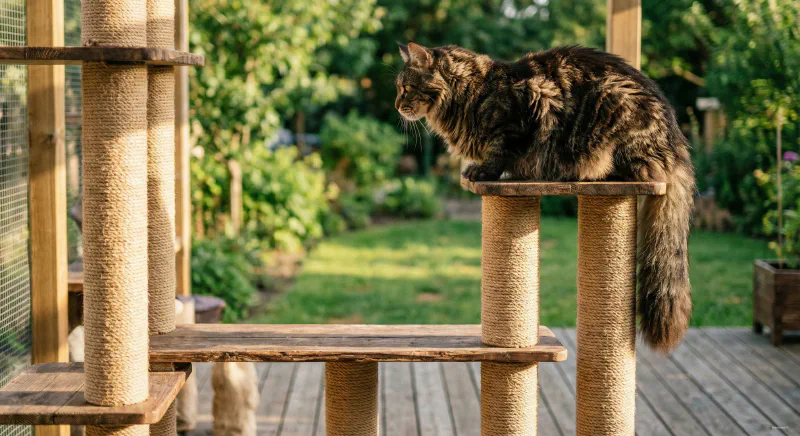
The first and most critical engineering standard to apply is the base-to-height ratio. The most common point of failure in commercial cat trees is a narrow base attempting to support a tall, top-heavy structure. As the cat climbs higher, the leverage they exert on the base increases exponentially, meaning a small footprint cannot provide the necessary counter-torque to prevent tipping. To support a Maine Coon safely, a tree requires a base plate that measures at least 24 inches square. Furthermore, the material of the base matters immensely. You must avoid hollow structures in favor of solid wood or double-thick reinforced engineered wood that provides the necessary ballast at the bottom to anchor the center of gravity.
The second criterion is the diameter of the vertical posts and the density of the sisal wrapping. Standard cat trees typically utilize narrow, 2.5-inch cardboard tubes wrapped in thin, decorative twine. These are wholly inadequate for a Maine Coon, whose paw can span nearly three inches in width. Thin posts do not provide enough surface area for a satisfying, full-stretch scratch, leading the cat to seek wider alternatives like your sofa arm. Moreover, cardboard tubes can buckle under the shear force of a heavy cat landing on a side perch. A proper heavy-duty tree must feature posts with a minimum diameter of 4.5 inches, wrapped in glued—not stapled—sisal rope. Stapled rope will unravel under the power of Maine Coon claws within weeks, leaving a bald and useless pole.
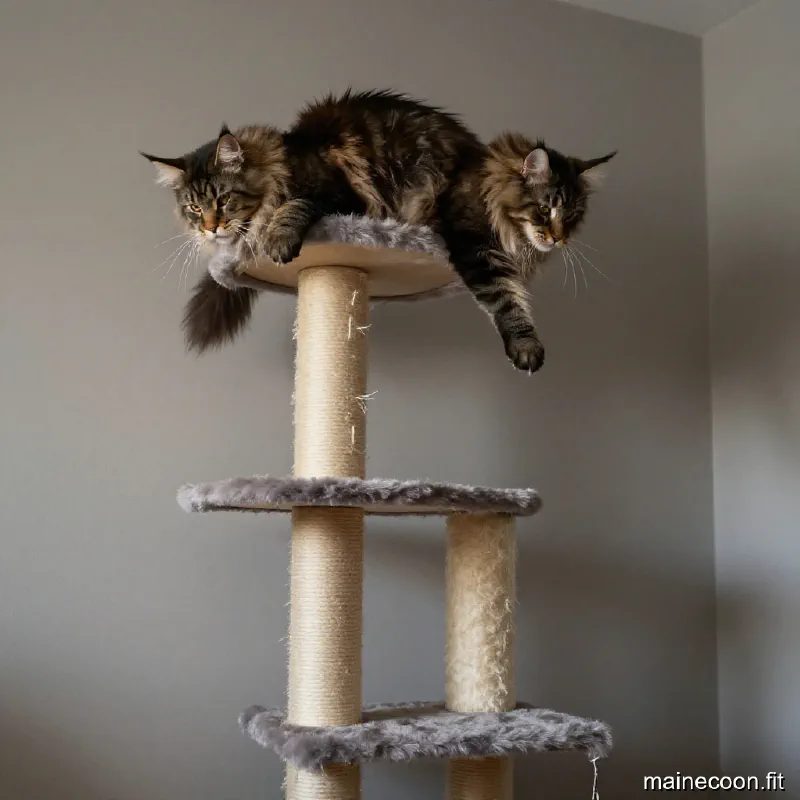
Finally, one must consider the usable surface area of the perches themselves. A standard “cup” perch is often only twelve inches in diameter, while a mature Maine Coon can measure forty inches from nose to tail. This leads to “spillage,” where the cat cannot fit comfortably and subsequently stops using the tree for rest, reducing it to a mere expensive scratching post. Platforms for this breed must be at least 16 by 20 inches to accommodate their length. If the tree features basket-style beds, they must be rated for at least twenty-five pounds to prevent the metal support bolt from bending under the load.
For those seeking the absolute pinnacle of stability and aesthetics, the “Furniture Grade” category is the gold standard. Trees in this class, such as those from Mau Lifestyle, act as permanent furniture pieces utilizing treated real tree branches rather than cardboard tubes. The primary advantage here is mass; these units typically weigh over forty-five pounds. The sheer weight of the real wood makes them nearly impossible to tip over without deliberate human effort, and the irregularity of the natural wood provides a superior grip for claws compared to perfectly smooth tubes.
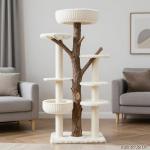
Mau Lifestyle Cento Cat Tree
Built from real tree branches and solid wood, this 46lb unit offers unmatched stability and deep baskets that can hold a 20lb cat without bending.
Check Price on Amazon →If function is prioritized over form, the “Indestructible” category offers the best scratching experience. These trees, often exemplified by brands like Cat Tree King, feature massive seven-inch diameter posts. This excessive width allows a Maine Coon to wrap their front paws fully around the post and hang their full body weight off it. This hanging behavior is a crucial stretching exercise that engages the flexor muscles of the claws and the extensor muscles of the spine, contributing to long-term musculoskeletal health.
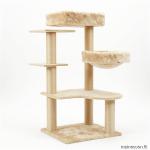
Maine Coon Cat Tree
The industrial choice. Features massive 7-inch posts and reinforced floating beds that are virtually impossible to break.
Check Price on Amazon →For owners on a stricter budget, it is possible to find safe options under $150, but it requires compromise on longevity and a strict adherence to safety protocols. Reinforced standard trees, such as specific large-cat lines from Feandrea, bolster the weak points of traditional designs with battened base plates. However, for these lighter trees, the installation of a wall anchor is non-negotiable. Because the tree lacks the mass to be freestanding against a Maine Coon’s momentum, it must be secured to a wall stud to artificially create stability. While the sisal may need replacing sooner than on premium models, the safety provided by the wall strap makes these a viable entry-level choice.
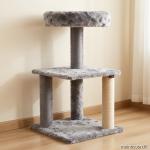
FEANDREA Large Cat Tree
A budget-friendly option that reinforces the base and offers a large condo. Must be anchored to the wall for safety.
Check Price on Amazon →According to the Cornell Feline Health Center, scratching is an innate, physiological imperative that serves to remove the dead outer layer of the claw and deposit territorial pheromones. Research indicates that cats prefer scratching surfaces that offer resistance; if a post wobbles when they pull, they instinctively deem it unsafe and move to a stable alternative. Therefore, investing in a stable tree is not just a gift to your cat; it is the single most effective way to protect your own furniture from destruction.
References#
- Cornell University College of Veterinary Medicine. (2023). Feline Behavior Problems: Destructive Scratching.
- The International Cat Association (TICA). Maine Coon Breed Standard: Size and Musculature.
- Journal of Veterinary Behavior. Environmental Enrichment for Indoor Cats: The importance of vertical space.