Reading a Pedigree: Understanding Your Cat’s Lineage & Codes#
If you bought your Maine Coon from a reputable breeder, you likely received a piece of paper that looks like a complex family tree. This is the Certified Pedigree.
To most owners, it looks like a list of strange names and confusing codes like “MCO n 22” or “Top 5.” But to a trained eye, this paper reveals the entire genetic history of your cat. It tells you if your cat is inbred, who their ancestors were, and what colors they carry.
Understanding a pedigree is the difference between buying a “purebred” and buying a cat with a healthy, diverse genetic background. Let’s decode the matrix.
The EMS Codes (The Secret Language)#
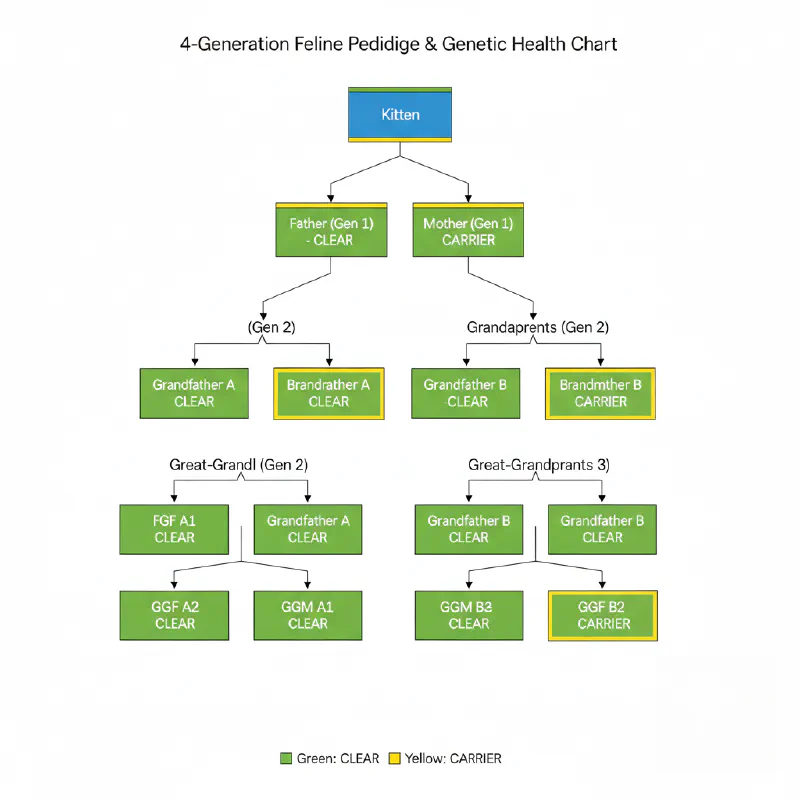
Breeders use the Easy Mind System (EMS) code to describe cats. You will see these codes next to the names of the ancestors.
Structure: [BREED] [COLOR] [PATTERN]
- MCO: This is the code for Maine Coon.
- Color Codes:
n= Blacka= Blue (Grey)d= Red (Orange)f= Tortoiseshellw= Whites= Silver/Smoke (e.g.,nsis Black Smoke)
- Pattern Codes:
09= With White (white paws/bib)22= Classic Tabby (bullseye pattern)23= Mackerel Tabby (tiger stripes)
Example: MCO n 22 = Maine Coon, Black, Classic Tabby (A standard brown tabby).
Example: MCO ns 09 = Maine Coon, Black Smoke, with White.
The COI (Coefficient of Inbreeding)#
This is the most critical number on the chart, though you often have to calculate it using a database like PawPeds.
The COI measures how closely related the parents are.
- 0%: Unrelated.
- 12.5%: Equivalent to breeding a grandfather to a granddaughter.
- 25%: Equivalent to breeding a brother to a sister.
What is Safe? In Maine Coons, the average COI is around 12-15% because all Maine Coons descend from a small group of “Foundation Cats.” However, responsible breeders try to keep this number as low as possible.
- Green Flag: COI under 10%.
- Yellow Flag: COI 10-15%.
- Red Flag: COI over 20%. High inbreeding increases the risk of genetic defects like SMA and immune system issues.
Foundation vs. Clones#
If you trace your pedigree back far enough (using the PawPeds database), you will hit the “Foundation Cats”—the original farm cats from Maine that started the breed in the 1960s/70s.
You might hear breeders talk about “The Clones.” These were five Maine Coons born in 1978 (offspring of Heidi Ho Sonkey Bill and Tanstaafl Polly Adeline). They had an incredible “show look” and were bred extensively.
Today, almost 35% of the genes in the entire Maine Coon breed come from these five cats. This is a “genetic bottleneck.”
Why it matters: Breeders who focus on “Outcrossing” or “Low Clones” are trying to preserve genetic diversity by finding lines that don’t have these five cats in every branch of the tree. Buying a “Low Clone” kitten supports the long-term health of the breed.
Titles: What is a CH, GC, or RW?#
You will see letters before the ancestor names. These are Show Titles.
- CH: Champion.
- GC / GIC: Grand Champion / Grand International Champion.
- RW: Regional Winner (Top 25 in their region).
- NW / WW: National Winner / World Winner.
If your kitten’s pedigree is full of “RW” and “GC,” it means the ancestors were judged to be excellent examples of the Breed Standard.
Conclusion#
Your pedigree is more than a receipt. It is a history book. It connects your cat to the rough-and-tumble barn cats of the 1950s and the show-stopping World Winners of the 90s. Treasure it.
Resources & Further Reading#
- PawPeds. (n.d.). Maine Coon Pedigree Database.
- The International Cat Association. (2023). EMS Code Reference Guide.