The “Seasonal Blow-Out”: Surviving Spring Shedding#
If you own a Maine Coon, you are familiar with fur. It’s on your clothes, in your coffee, and rolling like tumbleweeds down your hallway.
But twice a year, usually in Spring and Autumn, things escalate. You pet your cat, and a cloud of loose fur explodes into the air. You brush them, and you remove enough hair to knit a second cat.
This is the Seasonal Blow-Out.
Maine Coons have a “double coat.” They have long, silky guard hairs (the waterproof top layer) and a dense, woolly undercoat (insulation). When the days get longer in Spring, their biology tells them to dump that heavy winter insulation. If you don’t help them remove it, it will turn into massive, skin-tight mats within days.
Here is your survival guide to the shedding season.
The Tool Kit: Why Slicker Brushes Aren’t Enough#
Many owners use a “Slicker Brush” (the one with fine wire bristles). This is great for fluffing the top coat, but it does not reach the skin.
During a blow-out, the dead undercoat detaches from the skin but gets trapped under the guard hairs. A slicker brush just glides over the top. You need tools that go deep.
- The Greyhound Comb (Metal Comb): This is your primary weapon. It has long metal teeth that reach all the way to the skin. It finds the tangles that the brush misses.
- The Undercoat Rake: This looks like a tiny garden rake. It is designed to grab the loose woolly undercoat and pull it out without cutting the top coat.
- The Deshedding Tool (Use with Caution): Tools like the Furminator are blades. They cut the hair. While effective, they can damage the silky guard hairs of a Maine Coon if used too aggressively. Use them sparingly, only on the back, and never on the tail.
The Technique: Line Brushing#
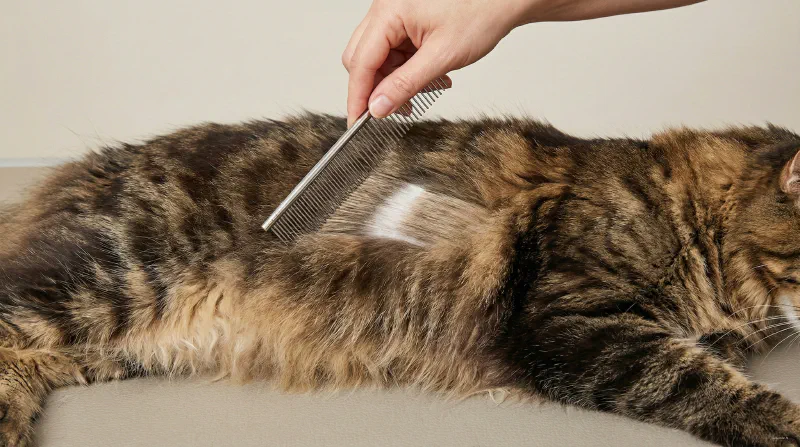
If you just brush the top, you are missing 90% of the dead hair. You must learn Line Brushing.
- Lay your cat on their side.
- Lift the fur up with your left hand so you can see a “line” of skin.
- Brush the fur below the part downwards, starting from the skin and brushing out.
- Move your line up an inch and repeat.
You are working layer by layer, from the belly up to the spine. This ensures you are removing the trapped dead hair right at the root, which is where mats form.
The “Danger Zones”#
During the blow-out, mats form fastest in high-friction areas. Check these spots daily:
- Armpits: The friction of walking felts the hair.
- Behind the Ears: Soft, fine hair here tangles instantly.
- The “Pantaloons”: The back legs rub together.
- Under the Collar: If your cat wears a collar, take it off daily to brush the neck.
Bathing: The Nuclear Option#
If the shedding is out of control, a bath and blow-dry is the most effective solution.
Water loosens the dead hair. A high-velocity dryer (the kind professional groomers use) literally blasts the loose water and dead hair off the skin.
- Note: Only do this if your cat tolerates bathing. If not, take them to a professional for a “De-Shedding Treatment.” It is worth every penny to have someone else deal with the fur storm.
Hairballs: The Internal Consequence#
When your cat grooms during a blow-out, they swallow massive amounts of hair. This can lead to vomiting or, worse, intestinal blockages.
- Prevention: Increase their intake of Omega-3s to help hair pass. Consider a hairball gel (laxative) during peak shedding weeks.
- Brushing: The more hair you remove with a comb, the less hair ends up in their stomach.
Conclusion#
The Seasonal Blow-Out is intense, but it is temporary. Commit to 10 minutes of line brushing every day for two weeks. Your vacuum cleaner will thank you, and your cat will be much more comfortable without that itchy, loose wool trapped against their skin.
Resources & Further Reading#
- National Cat Groomers Institute. (n.d.). The Science of Shedding.
- Veterinary Partner. (2022). Hairballs in Cats.