The Bottom Line#
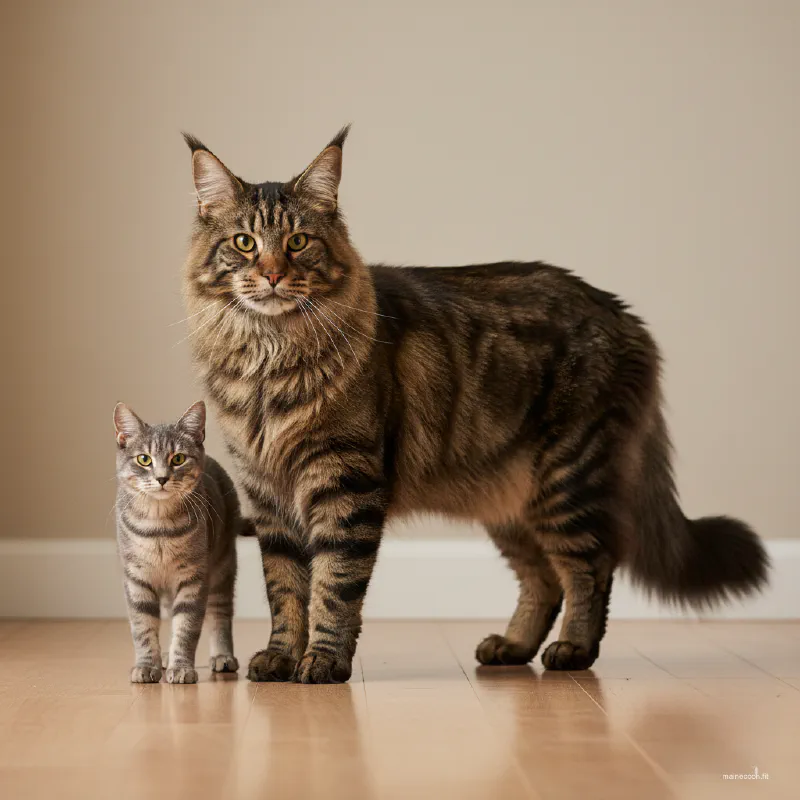
The internet is saturated with hyperbole regarding Maine Coon size, with dubious claims of 35-pound cats being the norm. These exaggerations set owners up for anxiety when their healthy 18-pound male fails to turn into a mythical monster. The reality is that the Maine Coon is indeed a giant, but “giant” is defined by bone structure and length, not just adipose tissue (fat). A healthy male typically ranges from 15 to 22 lbs, while females are generally 10 to 15 lbs. This guide provides a veterinary-referenced growth curve to help you track your cat’s progress, emphasizing that steady, consistent growth is far superior to rapid, obesity-fueled weight gain.
The Growth Curve: A Marathon, Not a Sprint#
The defining characteristic of Maine Coon growth is its duration. While a Domestic Shorthair (DSH) reaches 95% of its skeletal size by 9 months, a Maine Coon is still in the “linear growth” phase well into its second year.
- 0-12 Months (Skeletal Elongation): This is the vertical growth phase. Energy is directed toward lengthening the long bones. The cat may appear skinny or “ribby.”
- 1-3 Years (Muscular Development): Once the frame is established, the body begins to add muscle mass. The chest broadens, and the cat becomes heavier to lift.
- 3-5 Years (Maturation): The final stage involves the development of secondary sexual characteristics (like the stud jowls in males) and the full coat density.
Male vs. Female Growth Patterns#
Sexual dimorphism—the physical difference between sexes—is pronounced in this breed.
- Males: They grow longer and heavier. The growth curve for a male is steeper and lasts longer. A male kitten may gain 2 lbs per month during peak spurts.
- Females: They tend to reach their full skeletal length earlier (around 18 months) but will continue to build muscle density. They are often more elegant in type but possess the same heavy boning relative to their size.
Interpreting the Numbers: The Body Condition Score (BCS)#
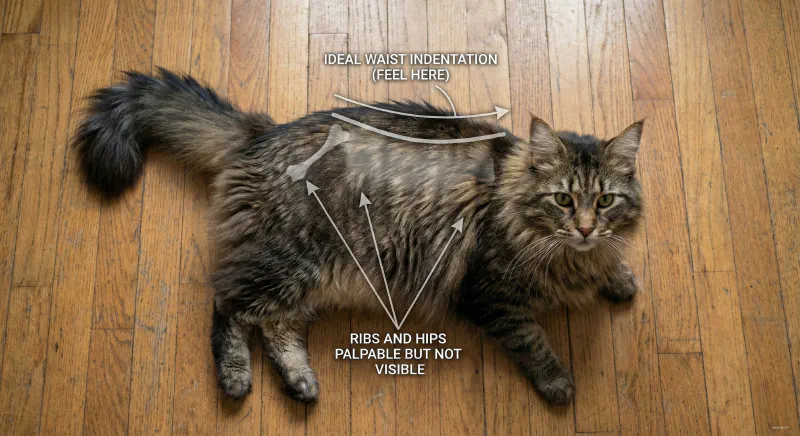
The number on the scale is irrelevant without context. A 20-pound cat can be a healthy, muscular specimen or a morbidly obese animal with joint pain. You must learn to palpate your cat to determine its true condition using the Body Condition Score (BCS) system.
- Underweight: Ribs, lumbar vertebrae, and pelvic bones are easily visible. No palpable fat.
- Ideal: Ribs palpable with minimal fat covering. Waist observed behind ribs when viewed from above.
- Overweight: Ribs difficult to palpate under heavy fat cover. Fat deposits on lumbar area and base of tail.
The “Runt” Phenomenon#
Growth is rarely linear. It is common for a Maine Coon kitten to stall for three weeks, causing owner panic, and then gain a pound in four days. This “stair-step” growth pattern is normal. Furthermore, the size of the kitten at 12 weeks is a poor predictor of adult size. Small kittens often catch up significantly in the second and third years. The only reliable predictor of size is the genetics of the parents (pedigree), not the size of the paws or the weight at 4 months.
Digital Pet Scale for Kittens & Adults
Weekly tracking is vital for kittens. This flat-platform scale accommodates large adults up to 40 lbs.
Check Price on Amazon →Conclusion#
While slow growth is normal, no growth or weight loss in a kitten is a medical emergency. If your kitten loses weight or fails to gain for more than two weeks, this warrants investigation for issues like parasites, malabsorption, or congenital defects. Conversely, if your cat is gaining weight rapidly but becoming round rather than long, you are likely overfeeding, putting dangerous stress on immature joints. Focus on the frame, not the fat.
References#
- Feline Nutrition: Nutrition for the Giant Breeds. UC Davis School of Veterinary Medicine.
- Vella, Carolyn, et al. Robinson’s Genetics for Cat Breeders and Veterinarians. Butterworth-Heinemann, 1999.
- “Growth Curves in the Domestic Cat.” Journal of Animal Physiology and Animal Nutrition.