Maine Coon Weight Chart: The Definitive Tracking Guide#
If you have just adopted a Maine Coon kitten, you are probably asking the question every owner asks: “How big will they actually get?”
The Maine Coon is the largest domesticated cat breed in the world. However, unlike a standard Tabby that reaches full size by its first birthday, a Maine Coon takes a much longer, scenic route to maturity. Their growth plates often do not fully fuse until they are 3 to 5 years old.
This guide moves beyond generic estimates. We have compiled data from veterinary studies (including the British Journal of Nutrition) and breeder averages to give you a realistic, safe, and healthy growth timeline.
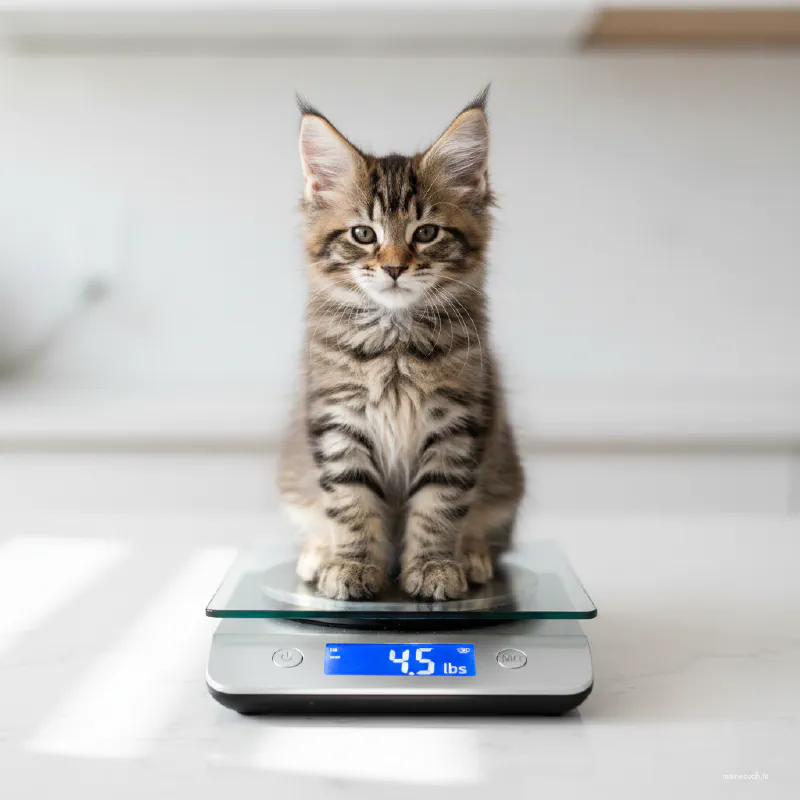
📊 The Master Weight Chart (Male vs. Female)#
Note: These ranges represent a “Healthy Average.” Remember that genetics play a huge role. It is always best to judge by your cat’s overall body condition rather than just the number on the scale.
| Age | Male Weight (lbs) | Male Weight (kg) | Female Weight (lbs) | Female Weight (kg) |
|---|---|---|---|---|
| Birth | 0.25 - 0.38 | 0.11 - 0.17 | 0.20 - 0.33 | 0.09 - 0.15 |
| 1 Month | 1.3 - 2.1 | 0.58 - 0.95 | 1.1 - 1.8 | 0.50 - 0.81 |
| 2 Months | 2.5 - 4.2 | 1.1 - 1.9 | 2.0 - 3.2 | 0.90 - 1.4 |
| 3 Months | 4.4 - 7.5 | 2.0 - 3.4 | 3.5 - 5.5 | 1.5 - 2.5 |
| 4 Months | 7.0 - 9.5 | 3.1 - 4.3 | 5.5 - 7.7 | 2.5 - 3.5 |
| 5 Months | 8.8 - 12.0 | 4.0 - 5.4 | 6.6 - 9.2 | 3.0 - 4.2 |
| 6 Months | 10.5 - 14.0 | 4.7 - 6.3 | 7.7 - 10.5 | 3.5 - 4.7 |
| 9 Months | 13.0 - 17.5 | 5.9 - 7.9 | 9.0 - 12.0 | 4.1 - 5.4 |
| 1 Year | 15.0 - 20.0 | 6.8 - 9.0 | 10.0 - 14.0 | 4.5 - 6.3 |
| 2 Years | 17.0 - 22.0 | 7.7 - 10.0 | 11.0 - 15.0 | 5.0 - 6.8 |
| 3-5 Years | 18.0 - 25.0+ | 8.1 - 11.3+ | 12.0 - 16.0+ | 5.4 - 7.2 |
🦴 Orthopedic Health: The Dangers of Rapid Growth#
The primary focus during the first 18 months of growth is orthopedic safety. While it is tempting to try and “power-feed” a kitten to encourage massive size, the soft cartilage and growth plates can be severely damaged if they grow too quickly.
1. The Hip Dysplasia Risk#
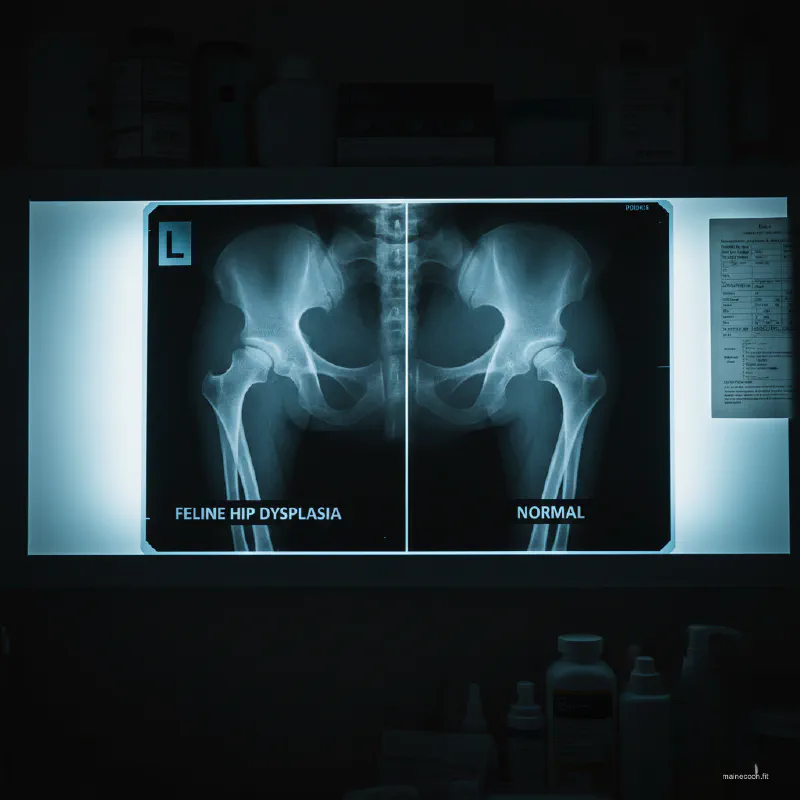
The problem is well-documented: Data from the Orthopedic Foundation for Animals (OFA) indicates that approximately 24.9% of Maine Coons evaluated suffer from Feline Hip Dysplasia (FHD).
- The Link: If the weight increases faster than the hip joint can properly form, the “ball” and “socket” do not align, leading to chronic arthritis later in life.
- Signs: Look for the subtle signs of pain: reluctance to jump, difficulty using a high-sided litter box, or a “bunny hopping” gait when running.
2. Slipped Capital Femoral Epiphysis (SCFE)#
As discussed in our Comprehensive Health Guide, SCFE is an acute orthopedic emergency in this breed.
- The Risk Factor: The condition targets young, overweight, neutered males.
- The Prevention: Strict weight management during the juvenile phase (6–18 months) is essential to reduce the load on the vulnerable hip growth plates.
3. The Neuter Timing Debate#
To mitigate the risk of SCFE, a growing consensus suggests delaying spay/neuter until 6–8 months of age. This allows the cat a longer exposure to natural hormones, which signal the growth plates to close and stabilize before the cat reaches its maximum weight.
🍽️ Fueling the Growth Spurt: Nutrition#
You cannot build a magnificent structure with inferior materials. The extended growth period of the Maine Coon requires a higher level of nutrient density than a standard adult cat.
Protein Density and Duration#
- The Rule: Many experts recommend keeping Maine Coons on a specialized Large Breed Kitten Formula or an “All Life Stages” food until they are 18 months old (instead of the standard 12 months). This guarantees the high protein and correct Calcium:Phosphorus ratio (ideally 1.2:1 to 1.5:1) required for orthopedic stability.
- The Warning: Switching to a generic “Adult Light” food too early is a common mistake that can stunt muscle development and compromise the skeletal structure.
See our Top 5 High-Protein Food Recommendations
Hydration and Weight Loss#
If your cat is overweight, the primary solution is not always less food, but more moisture.
- Strategy: Switch from dry kibble (10% moisture) to a high-quality wet food (78% moisture). This naturally reduces calorie density per volume while promoting kidney health.
❓ Troubleshooting Common Growth Questions#
When Will the Fur Erupt? (The “Mane” Development)#
The beautiful Ruff (mane) and the magnificent Lynx Tips (ear tufts) are the slowest to develop.
- Expectation: The full, glorious ruff often does not finish its growth cycle until the cat is 3 to 4 years old. Patience is key.
My Kitten is “Lanky”—Is it a Runt?#
If your 9-month-old male is 12 lbs but looks like a giraffe (long legs, short body hair), don’t worry.
- The Teen Phase: This is the “awkward phase.” The skeleton builds first (height and length), and the muscle mass/coat follows. They will spend their second and third years “filling out” that frame.
My Cat’s Weight Plateaued. Why?#
A temporary stall in weight gain often occurs around 6-9 months.
- The Shift: At this age, the cat’s body shifts focus from purely adding mass to building muscle density and strengthening bone. As long as your cat is active and eating well, a temporary plateau is normal.
Conclusion#
Successfully navigating the Maine Coon’s unique growth timeline requires vigilance, patience, and a commitment to breed-specific nutrition. By focusing on maintaining a lean body condition score—where you can feel their ribs easily but not see them—and providing the high-quality, balanced protein they need until age two, you mitigate the orthopedic risks associated with their size. The health partnership you form with your veterinarian during these crucial years is the foundation for a long, happy, and majestic life for your gentle giant.
📚 References#
- Orthopedic Foundation for Animals (OFA). (2020). Hip Dysplasia Statistics by Breed. (Source for 24.9% Dysplasia rate).
- British Journal of Nutrition. (2011). Birth weight and postnatal growth of pure-bred kittens. (Source for slow growth and birth weight data).
- Journal of Feline Medicine and Surgery. Slipped capital femoral epiphysis in 13 Maine Coon cats. (SCFE risk and neuter debate).
- Tufts University Cummings Veterinary Medical Center. (2023). Petfoodology: Reading Labels and Protein Density.
- Veterinary Genetics Laboratory (UC Davis). Canine and Feline Orthopedic Diseases. (Orthopedic protocols).