Maine Coon Tail Thinning: Why is My Cat Losing Fur?#
The tail is the pride of the Maine Coon. It is the flag they wave as they trot through the house. It is the blanket they use to keep their noses warm in the winter.
For many owners, the tail is the reason they bought the breed in the first place. You expect a flowing, luxurious plume that looks like a feather duster.
So, when that tail starts looking stringy, greasy, or thin, it is a source of major panic. I went through this with Atticus when he was about two years old.
One month, his tail was glorious. The next month, it looked like a wet rat’s tail. I was convinced he had a terrible skin disease or a nutritional deficiency.
The reality was much simpler, but also much grosser.
Before you rush to the vet assuming your cat has mange or ringworm, you need to understand the unique biology of the Maine Coon coat.
This breed produces an incredible amount of oil to waterproof their fur. Sometimes, that oil production goes into overdrive.
🛑 The Number One Culprit: Stud Tail#
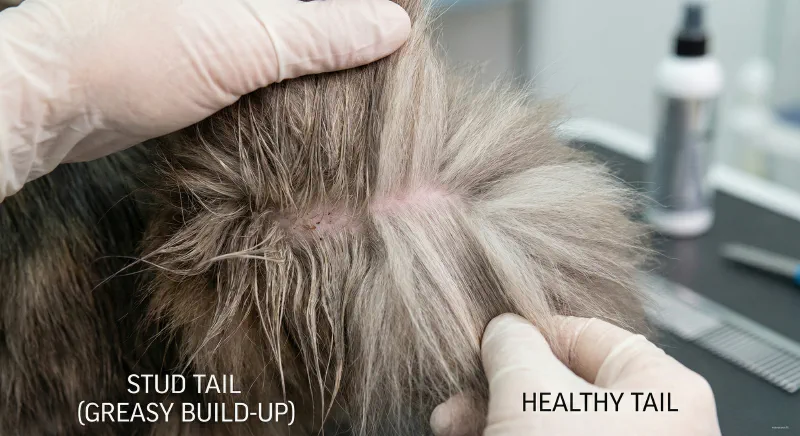
If you notice the fur at the base of the tail looking separated, wet, or matted, you are likely dealing with Supracaudal Gland Hyperplasia.
Breeders simply call this “Stud Tail.”
Every cat has a gland located on the top of their tail, right where it joins the body. This is a sebaceous gland that excretes oil.
In the wild, cats use this oil to mark their scent on bushes and trees. It is their personal signature.
In Maine Coons, this gland is often overactive. It pumps out waxy, brown sebum faster than the cat can clean it off.
This wax clogs the hair follicles. Just like a human pore gets clogged with oil and stops growing hair, the cat’s tail follicles get suffocated by this grease.
The hair dies and falls out, leaving you with a thinning, scraggly tail base.
💡 Amelia’s Note: Even though it is called “Stud Tail,” it does not just happen to unneutered male cats. My female, Penelope, gets it too. Neutered males and spayed females are all susceptible to this greasy condition.
How to Inspect for Stud Tail#
You need to get hands-on to diagnose this. Call your cat over and gently part the fur at the very base of the tail, right above the hips.
Look at the skin. Healthy skin should be pale pink or white.
If the skin looks yellow, waxy, or has black specks that look like dirt, you have a Stud Tail flare-up.
Touch the fur. Does it feel slick? Does it leave a residue on your fingers? That is the excess sebum.
If you do not treat this, it can turn into a bacterial infection called folliculitis, which is painful and requires antibiotics.
🛁 The Degreasing Protocol#
Fixing Stud Tail requires a specific grooming routine. Regular cat shampoo will not touch this grease.
It is like trying to wash butter off a pan with just water. You need a degreaser.
I recommend using a mechanic’s hand cleaner like Goop (the non-toxic, grooming version) or a specific degreasing cream for cats.
Apply the degreaser to the dry coat. Do not wet the cat yet. Rub the cream into the base of the tail right down to the skin.
Massage it in for a good two or three minutes to break down the wax. You really want to work it into the pores.
Once the grease is loosened, rinse the tail thoroughly with warm water. You will see the water turn grey or brown as the dirt lifts out.
After rinsing, follow up with a standard cat shampoo to remove any chemical residue. You may need to repeat this process once a week for a month to fully clear the clogged pores.
Once the pores are open, the hair will start to grow back.
🧠 Stress and Over-Grooming#
If the tail isn’t greasy but is still thinning, you need to watch your cat’s behavior.
Is your Maine Coon chewing on their tail?
Psychogenic Alopecia is a fancy term for stress grooming. Maine Coons are highly emotional, intelligent animals.
If they are bored, anxious, or lonely, they may soothe themselves by grooming excessively.
The tail is a common target for this anxiety. They will lick the same spot over and over until they act as a razor, shearing the hair off right at the skin level.
Identifying the Triggers#
Think about what has changed in your household recently.
Did you move furniture? Did you bring home a new baby or a new pet? Did your work schedule change?
Maine Coons thrive on routine. A disruption in their schedule can cause enough anxiety to trigger this self-mutilation behavior.
If you suspect stress is the cause, you need to increase their enrichment. Add more playtime with wand toys.
Build a routine that gives them predictable social interaction. Sometimes, distractors like a food puzzle can break the cycle of obsessive licking.
⚡ Feline Hyperesthesia Syndrome#
There is a neurological condition that specifically targets the tail area. It is called Feline Hyperesthesia Syndrome, or “Rolling Skin Disease.”
We have a full guide on this complex condition, but the hallmark sign is a ripple of skin along the spine followed by an attack on the tail.
If your cat seems to be fighting their tail as if it is an enemy snake, this is not normal grooming.
This is a seizure-like activity or a misfiring of the nerves.
The cat bites the tail to stop the tingling sensation. This biting rips out chunks of fur and can lead to open wounds.
If you see the skin rippling before the grooming starts, you need to video the behavior and see a vet immediately.
🐜 Parasites and Fungus#
We cannot ignore the medical basics.
Fleas love the base of the tail. It is their favorite spot on the cat. Even if you don’t see the bugs, you might see “flea dirt” (flea poop) which looks like black pepper.
Many cats are allergic to flea saliva. One single bite can cause a systemic reaction that makes the cat itch uncontrollably.
They will chew the fur off their tail trying to scratch the itch.
Ringworm is another culprit. Despite the name, it is a fungus, not a worm. It eats the keratin in the hair shaft, causing the hair to break off.
Ringworm usually presents as circular, bald patches rather than general thinning, but on a long-haired cat, it can be hard to see the pattern.
🩺 When to See a Vet#
If you have degreased the tail and treated for fleas, but the hair loss continues, it is time for a medical workup.
Thyroid issues can cause poor coat quality. While hyperthyroidism is more common in older cats, it can cause the hair to become brittle and fall out easily.
Hormonal imbalances in intact (unneutered) male cats can also lead to “Stud Tail” that is impossible to manage topically.
Neutering the cat often resolves the hormonal surge that causes the excessive oil production.
📝 Conclusion#
Don’t panic if your Maine Coon’s tail looks a little sad.
Start with a hygiene check. Part the fur and check for grease. Invest in a tub of Groomer’s Goop and start a weekly degreasing routine.
Monitor their mental health. Are they bored? Are they anxious?
Check for bugs. Ensure your flea prevention is up to date.
The tail will grow back, but it takes time. Maine Coon fur grows in cycles. It might take 3 to 6 months for a stripped tail to return to its full, glorious plume.
Be patient, keep it clean, and the fluff will return.
References & Further Reading#
- Veterinary Partner: Stud Tail in Cats.
- Cornell Feline Health Center: Feline Skin Conditions and Alopecia.
- Dermatology for Animals: Understanding Sebaceous Gland Disorders.