The Maine Coon Vaccination Protocol: Core vs. Non-Core Risks#
I recently had a new owner ask me, “If my Maine Coon never leaves the house, why does he need shots?”
It is a fair question. But the answer isn’t about where your cat goes; it is about what you bring home on your shoes.
Vaccinology has changed. We no longer blindly poke every cat every year. According to Dr. Niels Pedersen in Feline Husbandry, modern protocols focus on risk assessment to avoid over-vaccination while protecting against the “Big Three” killers.
Here is the definitive guide to what your giant needs, and what you might want to skip.
The “Core” Vaccines (The Non-Negotiables)#
Every Maine Coon, regardless of lifestyle, needs the FVRCP vaccine. This is the “Distemper” shot, but it actually covers three diseases:
- Feline Viral Rhinotracheitis (Herpes): The eye/sneeze virus.
- Calicivirus: The mouth ulcer/limping virus.
- Panleukopenia: The deadly “Parvo” gut virus.
Why they need it: Panleukopenia is so hardy it can travel into your house on your jeans after you walk through a park. Herpes and Calici are airborne.
The Protocol:
- Kittens: Shots at 8, 12, and 16 weeks. (The 16-week shot is crucial because maternal antibodies can block the earlier ones).
- Adults: A booster at 1 year.
- The Shift: After the 1-year booster, the AAFP (American Association of Feline Practitioners) now recommends boosting only every 3 years, not annually.
The “Non-Core” Vaccines (The Lifestyle Choice)#
1. FeLV (Feline Leukemia)#
- The Risk: FeLV is spread by saliva (biting, grooming).
- The Verdict: If your Maine Coon goes outside or lives with a FeLV+ cat, get it. If he is strictly indoor-only and you don’t foster stray cats, most vets agree you can skip it after the kitten series.
2. Rabies#
- The Law: In most US states and many countries, Rabies vaccination is mandatory by law, regardless of indoor status.
- The Safety Tip: Ask for the non-adjuvanted vaccine (like PureVax). It causes less inflammation at the injection site.
The “Sarcoma” Risk (VAS)#
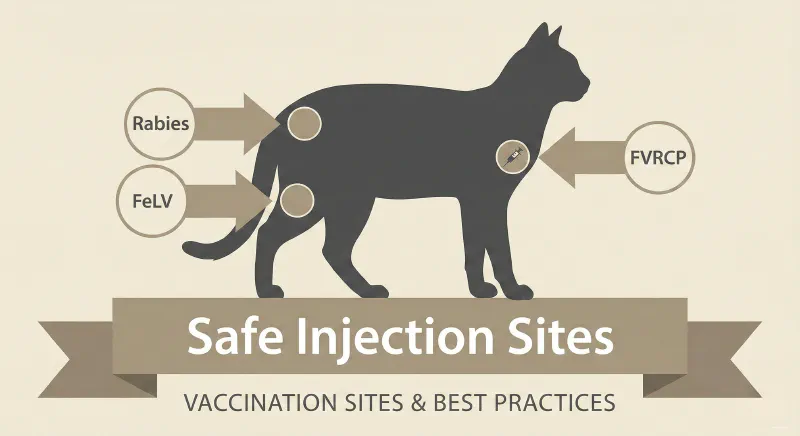
This is the scary part. Cats are unique in that they can develop cancer (Vaccine Associated Sarcoma) at the site of an injection.
- The Frequency: Rare (1 in 10,000 to 1 in 30,000).
- The Prevention: This is why we stopped vaccinating every year. Fewer pokes = lower risk.
- The Location: Never let a vet inject between the shoulder blades. Vaccines should go low on the legs (Right Front for FVRCP, Right Rear for Rabies). If a tumor forms, the leg can be amputated. You cannot amputate the spine.
Conclusion#
Vaccines are a miracle of modern medicine, but they are medical procedures, not candy. Stick to the Core FVRCP, follow the 3-Year Rule for adults, and always ask for Leg Injections.
References#
- Pedersen, N.C. (1991). Feline Husbandry. “Immunization,” p. 163.
- American Association of Feline Practitioners (AAFP). Feline Vaccination Guidelines.
- Journal of the American Veterinary Medical Association. Vaccine-Associated Sarcomas in Cats.
- Scherk, M.A. et al. (2013). “Disease Prevention and Management.” Journal of Feline Medicine and Surgery.