Polycystic Kidney Disease (PKD) in Maine Coons: Rare but Real#
When breeders talk about PKD (Polycystic Kidney Disease), they usually look at the Persian breeders. It is the scourge of the Persian breed. But Maine Coon owners cannot be complacent.
While rare, PKD does exist in the Maine Coon gene pool. Robinson’s Genetics notes that PKD is an “autosomal dominant” trait, meaning it only takes one parent to pass it on.
Why is a Persian disease in our Maine Coons? The answer lies in the “Outcrossing” history of the breed.
The “Secret” Persian Ancestors#
In the early days of the cat fancy (and during the breed’s reconstruction in the 1950s), breeders sometimes outcrossed Maine Coons to Persians to improve coat length and boning.
- The Legacy: While this improved the look, it introduced the PKD gene. Because the gene is dominant, it persists in lines that are not rigorously tested.
What is PKD?#
PKD causes fluid-filled cysts to form in the kidneys.
- Birth: The kitten is born with tiny cysts.
- Growth: As the cat ages, the cysts grow, crushing the healthy kidney tissue.
- Failure: Eventually (usually by age 7), the kidneys fail. The cat drinks excessive water, loses weight, and becomes toxic.
The Diagnosis: Ultrasound vs. DNA#
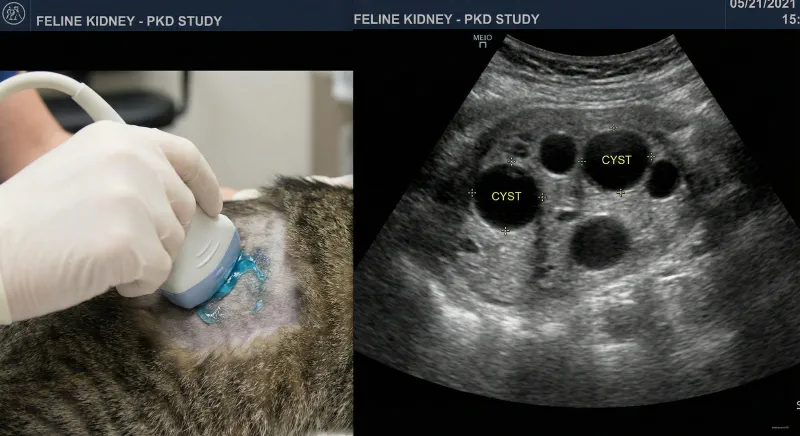
Because PKD is a “Deferred Lethal” (it kills you later), a cat can breed for years before showing symptoms.
- DNA Test: There is a swab test for the specific Persian PKD1 mutation. This detects 99% of cases.
- Ultrasound: The gold standard. A vet can see the cysts in a kitten as young as 10 months old.
Conclusion#
If you are buying a Maine Coon, ask for the PKD Status of the parents. Even though it is rare, it is a death sentence that is easily avoided. A responsible breeder will have “PKD Negative” on their website.
References#
- Vella, C. et al. (1999). Robinson’s Genetics. “Polycystic kidney disease,” p. 187.
- Biller, D.S. (1996). Inheritance of Polycystic Kidney Disease in Cats.
- Pedersen, N.C. Feline Husbandry. “Renal Anomalies,” p. 117.
- Walsh, L.G. The Maine Coon Cat. “Maine Coon Health Watch,” p. 88.