Introduction: The Sensory Overload#
Walking into a cat show for the first time is a sensory assault. You might expect a quiet room of sleeping cats, but what you get is a cacophony of loudspeaker announcements calling numbers to rings, the distinct smell of bay rum grooming spray, and the intense, frantic energy of exhibitors trying to get one last knot out of a tail. For the uninitiated, the “Cat Fancy” looks like a beauty pageant, but scratch the surface, and you realize it is a strategic sport with a rulebook thicker than the US Tax Code and a set of unwritten social laws that can get you ostracized—or disqualified—if you break them.
You are no longer just a pet owner; you are an exhibitor. Your goal this weekend is not just to win a ribbon, but to survive the experience without embarrassing yourself, annoying the judges, or stressing out your cat. This guide is your crash course in show hall survival, specifically tailored for the Maine Coon owner.
The “Pre-Game”: Preparation & Entry#
You cannot simply show up at the door with your cat and five dollars; the process begins months before the show hall doors open. The first hurdle is navigating the entry forms, often found on platforms like TOES or EntryClerk. In the US, you will likely show in either CFA (Cat Fanciers’ Association) or TICA (The International Cat Association). CFA is often viewed as the conservative grandmother of the fancy, where the Maine Coon Breed Standard favors a sweet expression, whereas TICA is the “science fair”—looser, louder, and generally more welcoming to the feral look.
When filling out your form, you must select the correct class or risk immediate disqualification. Most rookies should enter the Premiership (CFA) or Alter (TICA) class. These categories are specifically designed for spayed or neutered cats. Unlike the Championship class, which is for intact breeding animals filled with hormones, the Alter class is often more relaxed and fun, though the competition remains fierce. If your Maine Coon is between four and eight months old, you will enter the Kitten class, which serves as a training ground for the adult competitions. Even if your cat lacks papers or has a “fault” like a white locket, the Household Pet (HHP) class offers a fantastic entry point into the world of showing.
Once entered, you must manage the “grooming window.” New exhibitors often make the fatal mistake of washing the cat the night before the show. A Maine Coon’s coat needs time to settle; if you wash them Friday night, their fur will be “fly-away” and static-charged on Saturday morning. Instead, follow our Show Bath Grooming Guide and bathe them on Wednesday or Thursday. This allows natural oils to return slightly, giving the coat the necessary weight and drape to hang correctly on the judging table.
Before heading out, perform a final check for disqualifying faults. A single flea or ear mite will get you “red-carded” and sent home immediately, making you a pariah in the hall. Aggression is another deal-breaker; if your cat bites, your day is over. Finally, remember that you cannot show a shaved cat. As discussed in our Lion Cut Guide, hair length is a critical part of the scoring, so if you shaved your cat for summer, you must wait for the coat to grow back fully.
The “Go-Bag”: What to Pack#
A cat show is an endurance event where you will be stuck in the hall from early morning until evening. Since there is rarely a Walmart nearby, your packing list is critical. The most important item is your cage curtains. When you arrive, you will be given a bare wire cage, and you strictly must cover the sides, back, and top. This is a matter of hygiene and stress management; if your male Maine Coon locks eyes with a stud cat in the next cage, the resulting spray or screaming match will ruin your day. Beginners can use bath towels and binder clips, while veterans often sew elaborate custom curtains.
You also need a “ringside” grooming kit to fix your cat seconds before the judge sees them. This should include a metal greyhound comb for the final fluff, antistatic spray to combat the dry air of the show hall, and cornstarch or powder to absorb any last-minute grease behind the ears. For a complete checklist, refer to our Ultimate Grooming Toolkit.
Do not forget human comforts. Most halls provide cold metal folding chairs, so bringing a cushion is wise. You will need cash for raffles and vendors, and hand sanitizer is mandatory to protect yourself and your cat from germs. Finally, keep your documentation handy, specifically your confirmation slip and vaccination records, as a Rabies certificate is often required for entry.
Arrival & The Benching Cage#
The doors usually open for exhibitors around 7:30 AM. Punctuality is key; if you miss the check-in window, you are marked absent, and the judges will skip your number all day. Before you can enter the hall, you may pass through a “Vet Check,” where a veterinarian will quickly inspect your cat for fleas, ear mites, or fungal lesions like ringworm. Signs of general illness, such as sneezing or runny eyes, will also get you sent home to protect the other cats.
Once cleared, you will find your assigned row and cage, marked with a card bearing your name and your cat’s entry number.
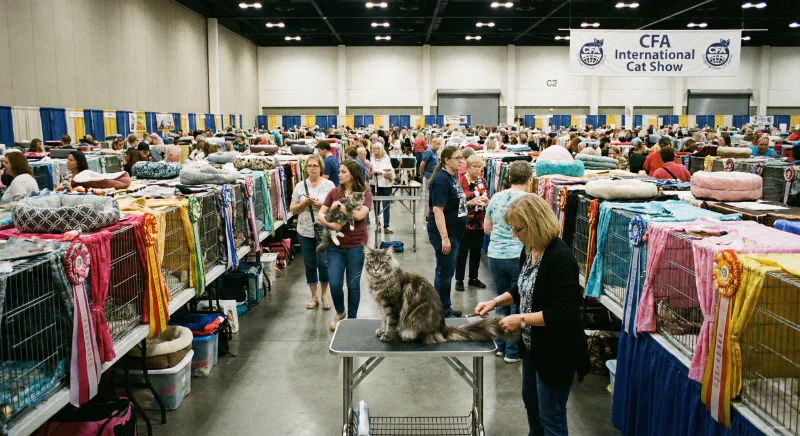
Setting up your “home base” requires adhering to benching etiquette. Always clip up your curtains to cover the back, sides, and top before putting your cat inside. If you paid for extra grooming space, be careful not to spill over into your neighbor’s area, as space is tight. It is also good practice to wipe down the wire cage with disinfectant wipes before setting up, as you never know who occupied it the previous week.
The golden rule of benching is simple: never touch another exhibitor’s cat without explicit permission. Breeders are paranoid about disease transmission, and for good reason. Even if you just sanitized your hands, they do not want you petting their show cat right before a ring. As detailed in our FIP Guide, preventing viral spread is a top priority in catteries.
The Judging Ring Protocol#
The main event happens in the judging rings, which run simultaneously. You must listen closely to the announcer. When you hear a call like “Maine Coon Championship to Ring 3,” check your catalog. If your cat is in that class, grab them and move immediately. If you miss your call, the judge will not wait, and you will be marked absent, losing the chance for points in that ring.
Transport your cat securely using the “football hold,” keeping their body tucked against your side with your forearm supporting their weight. Do not let your cat face other cats while walking, and do not stop to chat; getting to the ring is your priority. Once there, find the cage with your specific number on top, place your cat inside, latch the door securely, and sit in the chairs in front of the ring.
Once the judge begins handling cats, silence is golden. You must not identify your cat by name or shout instructions like “he likes his chin scratched.” Judging is anonymous, and identifying your cat can get you disqualified. Furthermore, do not distract the cat by waving toys or snapping your fingers to get them to look at you, as this interferes with the judge’s assessment of the cat’s temperament.
Even “Gentle Giants” can have bad days. As noted in our Personality Guide, show halls are stressful. If your cat hisses or swipes, stay calm and do not rush the stage unless the judge asks for help. If the cat is too aggressive, the judge may issue an “Unable to be Handled” card. This disqualifies you from that specific ring, but you can usually try again in the next one unless the cat is deemed truly dangerous.
The “Gallery” & Spectators#
Around lunchtime, the show hall opens to the general public, shifting your role from competitor to breed ambassador. You will likely be asked “Can I pet him?” a hundred times. You are never required to say yes. A polite refusal explaining that he is waiting to be judged and you need to maintain his grooming is perfectly acceptable. If your cat is relaxed and finished for the day, you may allow it, but always ask them to sanitize their hands first.
You may also spot spectators waving toys at cats inside the judging ring. This is a major faux pas known as the “Teaser Rule.” Distracting a cat while it is being judged ruins the assessment of their profile and temperament. If you see this happening, it is appropriate to politely ask them to stop.
Understanding the Ribbons & Titles#
To the rookie, the ribbon hierarchy can be confusing, but it generally follows a pattern. in the initial judging, your cat competes only against other Maine Coons of the same color and gender. A Blue Ribbon indicates 1st Place (Best of Color/Division), a Red Ribbon is 2nd, and Yellow is 3rd. In CFA, the Winners Ribbon is the specific award that counts toward the “Champion” title.
The real goal, however, is the “Final.” After the judge sees every cat in the show, they will pick their overall “Top 10” from all breeds. If you hear your number called for a final, you have achieved the holy grail of showing and earned major points. These accumulate over the season to earn prestigious titles like Grand Champion (GC) or Regional Winner (RW).
Regardless of the outcome, sportsmanship is the unwritten law of the hall. The person you beat today might be the one holding your cat for you tomorrow. Always congratulate the winner, even if you privately think your Maine Coon had better ear tufts. Avoid “bench glowering”—sulking at your cage if you lose. Instead, wait until the ring is closed and politely ask the judge what they liked about the winner. It is the single best way to learn the intricacies of the breed standard.
Conclusion#
Showing is an addiction. It is expensive, tiring, and stressful. But the camaraderie of the show hall—sitting with other “crazy cat people” who understand why you own five vacuums—is unlike any other community on earth.
References & Further Reading#
To ensure you are fully prepared for your first show, we recommend consulting the official rulebooks of the major cat federations. These documents provide the definitive final word on disqualifications, class structures, and code of conduct.
- The Cat Fanciers’ Association (CFA): New Exhibitor Overview – The official guide for navigating CFA shows, including detailed breakdowns of the ribbon hierarchy and benching requirements.
- The International Cat Association (TICA): Exhibitor’s Guide – A comprehensive resource for TICA’s “friendly and fun” show format, including specific rules for the Alter class.
- Walsh, L.G. (2013): The Maine Coon Cat – An essential text for understanding the specific breed standards and grooming requirements that judges look for in the ring.
- Cat Fanciers’ Almanac: Novice Exhibitor Tips – A collection of articles regarding show hall etiquette and communicating with judges.