The “M” Stands for… Myth?#
If you walk into any animal shelter in America, point to a large, fluffy tabby cat, and ask the volunteer what breed it is, they will almost certainly say, “That’s a Maine Coon mix.” It is the most common label in the cat world, yet it is rarely accurate.
The confusion stems from a fundamental misunderstanding of feline genetics. “Tabby” is not a breed; it is a coat pattern. In fact, it is the original pattern of the wild African wildcat (Felis lybica) from which all domestic cats descend. The Maine Coon, on the other hand, is a distinct breed with a specific skeletal structure, history, and genetic makeup.
So, if you have a large cat with stripes and an “M” on its forehead, how do you know if you have a “Part-Giant” or just a spectacular Domestic Longhair (DLH)? The answer lies not in the paint job (the coat), but in the chassis (the bone structure).
The “M” Marking Myth#
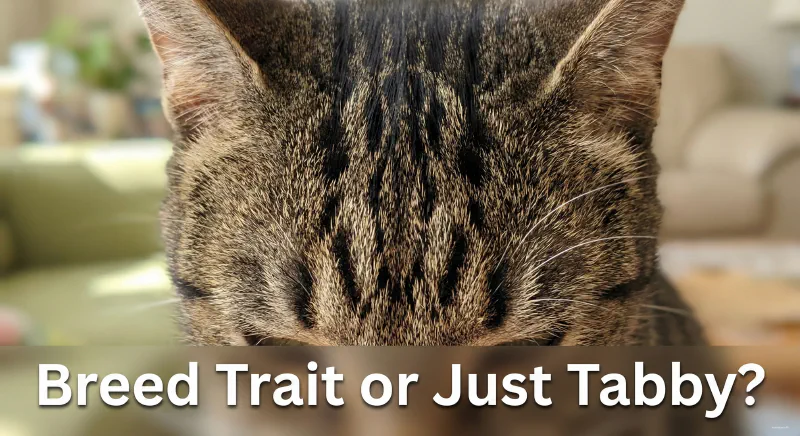
Let’s get the biggest myth out of the way immediately. The “M” on the forehead does not stand for Maine Coon.
Legends abound regarding this marking—some say it stands for “Mau” (Egyptian for cat), others say it marks the blessing of the Virgin Mary or the Prophet Mohammed. Biologically, it is simply the visible expression of the Agouti gene complex that creates the tabby pattern. You will find the “M” on Abyssinians, Bengals, Siberians, and yes, standard alley cats. Using the “M” to identify a Maine Coon is like looking for a Ferrari by checking if the car has tires.
The Physical Audit: Structural Identifiers#
To identify a true Maine Coon mix, you must look past the fur. A mix often inherits the dominant physical traits of the Maine Coon parent, specifically regarding bone structure.
1. The Muzzle Box (The Strongest Indicator)#
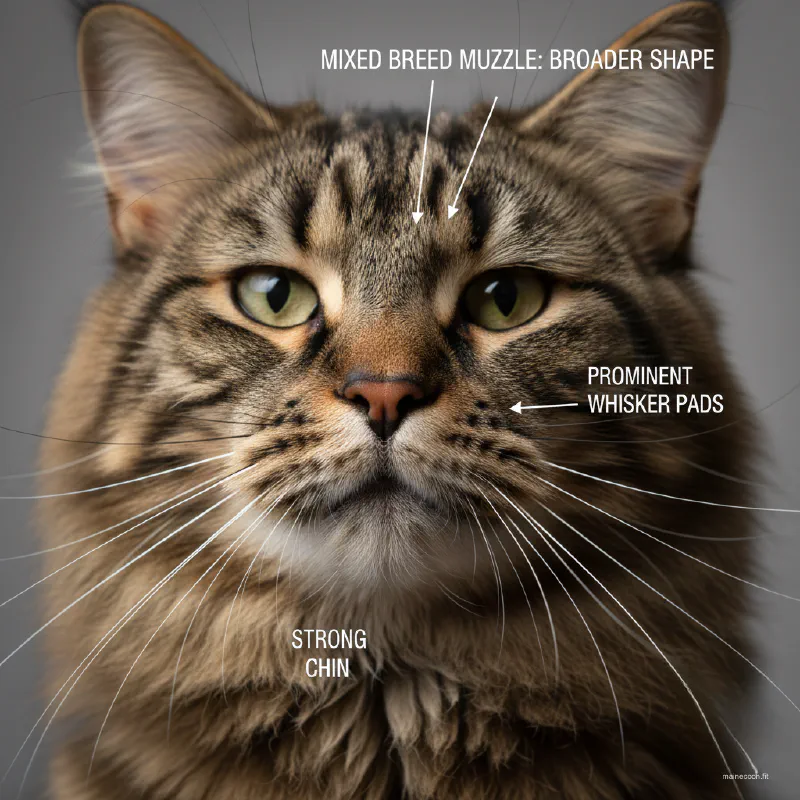
The single most reliable physical trait of a Maine Coon is the muzzle. A standard Domestic Longhair typically has a triangular, tapered face that narrows at the nose.
A Maine Coon (and often its mixes) possesses a distinct square muzzle. This is often referred to as “the box.” When you look at the cat straight on, the jawline should appear broad and rectangular, not pointed. Even in mixes, this strong chin and heavy jaw often persist. If your cat has a delicate, heart-shaped face, it is likely a DLH, regardless of how long its fur is.
2. The Rectangular Body Shape#
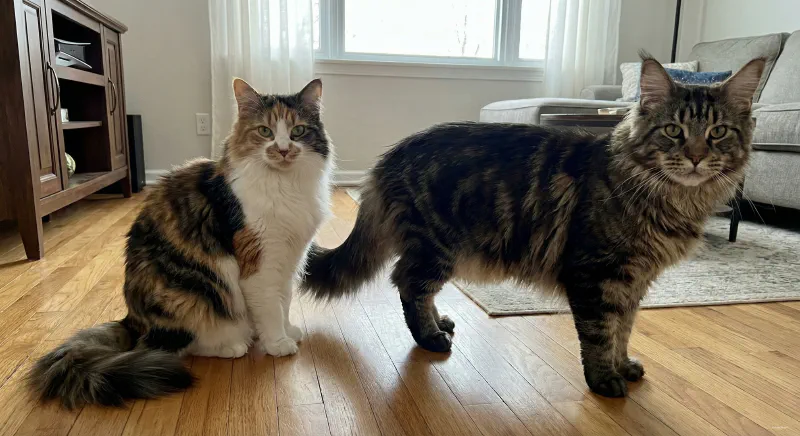
Most cats are compact. When they sit, they curl into a neat circle. Maine Coons are distinctively rectangular. They have long, broad backs that do not taper significantly towards the tail.
When a Maine Coon mix stands, their legs often appear thick and column-like (heavy boning) rather than spindly. If you pick up your cat, do they feel surprisingly heavy for their size? Maine Coons are dense creatures. A mix might not reach the 20lb mark of a purebred, but they often retain the “long and tall” stature that makes them look larger than they actually are.
3. The Coat Texture Difference#
Not all long hair is created equal. A standard Domestic Longhair coat is usually soft, cottony, and uniform in length across the body. It feels like a cloud and often mats easily because it lacks structure.
The Maine Coon coat is completely different. It is a “shag” coat designed for weather resistance in the harsh Maine winters. It feels slightly oily, coarser, and is distinctly uneven. A mix often inherits this functional coat, featuring a shorter length on the shoulders that gets longer towards the tail. You should look for the specific “ruff and breeches”—the lion-like mane around the neck and the fluffy “pantaloons” on the rear legs. If your cat’s fur feels slightly oily or if they seem surprisingly dry after walking in the rain, that water-resistant texture is a strong indicator of Maine Coon heritage.
Personality: The “Dog Software”#
Sometimes, the behavior tells you more than the body. Maine Coon genetics are potent when it comes to personality, often overriding the typical aloof nature of a domestic cat. If your tabby acts more like a Golden Retriever than a feline, pay attention.
These cats suffer from “Shadow Syndrome,” a tendency to follow their owners from room to room, demanding involvement in every activity. Unlike a standard cat that meows, a Maine Coon mix will often chirp, trill, or make noises that sound surprisingly bird-like. This distinct vocalization is highly hereditary. You might also notice a strange fascination with water; while they may not swim laps, they will frequently paw at their water bowl, sit on the edge of the shower, or play in the sink. Finally, look at their paws. Maine Coons are incredibly tactile and will use their paws like hands to scoop up food, open cabinets, or tap your face to wake you up.
The Verdict: How to Be 100% Sure#
Visual identification is fun, but it is effectively a guessing game. Phenotype (how a cat looks) does not always match Genotype (genetics). A cat can have 0% Maine Coon DNA and still look like a giant due to random genetic chance. Conversely, a mix might look like a standard shorthair but carry the personality traits of its Maine Coon parent.
If you truly want to know if your giant tabby is a Maine Coon mix, the only definitive method is a genetic test. Modern DNA panels can break down a cat’s lineage by percentage, separating the “Maine Coon” markers from “Western European Domestic Cat” markers.

Wisdom Panel Cat DNA Test
Stop guessing. This test compares your cat's DNA against the world's largest breed database to tell you exactly how much Maine Coon is in the mix.
Check Price on Amazon →Summary#
Before you declare your cat a mix, weigh the evidence carefully. If your cat combines that heavy, rectangular bone structure with a square muzzle, a water-resistant shag coat, and a personality that chirps and follows you like a shadow, there is a very good chance you are sharing your home with a descendant of the gentle giants.
References#
- The Maine Coon Breed Standard - The Cat Fanciers’ Association (CFA).
- Robinson’s Genetics for Cat Breeders and Veterinarians - Carolyn M. Vella.