The Bottom Line#
If you are just looking for the quick answer: Do not buy a standard plastic feeder for a Maine Coon. They will tip it, hack it, or break into it within 48 hours.
Maine Coons require “heavy-duty” or “dog-grade” feeders. You need a unit with a locking lid (twist-lock or latch), a sealed dispensing chute (to prevent paw-intrusion), and a low center of gravity. For multi-cat households, a microchip feeder is non-negotiable to prevent food theft.
Below, I detail exactly why standard feeders fail and which specific mechanisms survive the “Maine Coon stress test.”
The 4 AM Negotiation#
If you are reading this, you probably haven’t slept past 4:30 AM in weeks.
I have been there. My first Maine Coon, Leo, didn’t just meow for breakfast. He treated it like a hostage negotiation. First came the polite chirps. Then the paw taps on my face. Finally, the “nuclear option”: knocking items off the nightstand until I surrendered.
I bought an automatic feeder to save my sleep schedule. It lasted three days.
Leo realized that if he body-slammed the cheap plastic tower, it would vibrate enough to drop a few nuggets of kibble. It became his personal slot machine. By day four, he had knocked the lid off entirely and gorged himself on a week’s worth of food.
Maine Coons are different. They have the intelligence of a toddler, the strength of a medium dog, and paws that are shockingly good at picking locks. If you want to disassociate yourself from food (and stop the face-pawing at dawn), you cannot buy the cute, aesthetic feeder you saw on Instagram. You need a tank.
Why Standard Feeders Fail the “Coon Test”#
Most automatic feeders are designed for 10-pound domestic shorthairs who gently wait for dinner. Maine Coons present three unique engineering challenges that cheap motors can’t handle.
1. The “Raccoon” Paws#
Maine Coons use their paws like hands. A standard gravity flap is useless against them. They will lie on their backs, slide a paw up the chute, and manually rotate the internal paddles to dispense food. I have watched security camera footage of my cat doing this for 20 minutes straight. It is impressive, but expensive.
2. The Body Slam#
A 20-pound cat running at full speed generates significant force. Top-heavy feeders tip over instantly. Once on the floor, the impact usually pops the lid off, creating an all-you-can-eat buffet. Even if the lid stays on, the impact often breaks the internal plastic gears.
3. Whisker Stress#
Maine Coons have massive whisker pads. The small, deep plastic bowls that come with standard feeders cause “whisker fatigue”—a sensory overload that makes eating painful. If the bowl is too narrow, your cat might paw the food out onto the floor to eat it, defeating the purpose of a clean, automated system.
The Anatomy of a Maine Coon-Proof Feeder#
Over the years, I have tested (and Leo has destroyed) half a dozen models. I have learned that “Dog Proof” is usually the correct search term. Here are the non-negotiable features you need.
The Locking Lid A friction-fit lid is garbage. You need a lid that requires opposable thumbs to open. Look for twist-lock mechanisms (where you have to rotate the lid 90 degrees to release it) or dual-button latches. If you can open it with one hand, your cat can open it with one paw.
The Conveyor vs. Paddle System Most cheap feeders use a rotating paddle at the bottom. Clever cats can spin this. Better feeders use a conveyor belt system or a distinct “locking” rotor that freezes in place between meals. This prevents the “paw-up-the-chute” hack.
Power Redundancy Maine Coons are notorious for chewing cords. You need a feeder that runs on a DC adapter but has battery backup (usually D-cell batteries). When (not if) your cat unplugs the unit during a zoomie session, the schedule must continue.
Solving the Multi-Cat Problem#
If you have one Maine Coon and one regular cat, you likely have a different problem: The Bully.
Maine Coons eat fast and heavily. If you have a free-feeding station or a standard automatic feeder, the Maine Coon will often push the smaller cat aside and eat both portions. This leads to an overweight Maine Coon and an underweight sibling.
The Microchip Solution#
The only way to solve this without locking cats in separate rooms is a Microchip Feeder.
These units have a plastic arch that covers the bowl. The lid remains sealed until a cat puts their head under the arch. The feeder scans the cat’s ISO microchip (the one injected by the vet).
- If it’s the right cat: The lid slides open.
- If it’s the wrong cat (the intruder): The lid stays shut.
I use this for my smaller cat. My Maine Coon, try as he might, cannot hack it. He has sat on top of it, pawed at the sides, and even tried to squeeze his head in from the back. The motor held strong. It is the only reason my smaller cat gets to eat in peace.
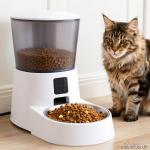
SureFeed Microchip Pet Feeder
The only way to stop food theft in a multi-cat home. Scans your cat's microchip and only opens for the correct pet.
Check Price on Amazon →Specific Recommendations for Large Cats#
Note: Since specific models go out of stock or change names constantly on Amazon, I am linking to the search categories that yield the correct “heavy-duty” results.
1. The Heavyweight Champion (Large Capacity)#
For a single Maine Coon, you want a feeder with a wide base and a locking hopper. Look for models that advertise “clog-free” designs, as Maine Coon kibble (like Royal Canin Maine Coon) is much larger than standard kibble and often jams smaller machines.
Key Features to Look For:
- 4L to 6L capacity (large hopper).
- Stainless steel bowl (hygienic and chin-acne preventing).
- “Anti-clog” technology for large kibble pieces (12mm-15mm).
Large Feeder
Designed with a wide rotor to handle large freeze-dried or Maine Coon kibble without jamming. Features a locking lid.
Check Price on Amazon →2. The “Wet Food” Feeder#
Dry food is convenient, but as we discussed in the Nutrition Guide, moisture is critical. Can you automate wet food? Yes, but with limits.
These feeders use a rotating carousel with ice packs underneath. They keep the food fresh for about 6-8 hours. I use this for the 4 AM meal specifically. I load it right before bed with a small portion of raw or wet food. When the timer goes off, it spins to reveal the fresh meal.
The Downside: They are lighter and easier to break into. You might need to secure this unit to a heavy board or the floor using Velcro strips.
Reddit Reality Check#
I spent hours combing through r/MaineCoon and r/CatAdvice to see what the community is saying. The consensus confirms my experience: standard feeders are a waste of money.
The “Food Heist” Stories User u/GiantPaw shared a video of their Maine Coon tipping a $100 feeder off the kitchen counter to shatter the hopper. The community advice? “Velcro it to the floor.” Almost every experienced owner recommends securing the feeder physically, regardless of the brand.
The Kibble Size Issue Many owners reported that generic feeders jam constantly with Maine Coon specific kibble (which is large and square).
“I came home to a screaming cat because the Royal Canin kibble got stuck in the chute. You have to buy a feeder meant for dogs or one with an adjustable rotor.” — u/CoonMom99
The “Intruder” Mode Interestingly, several users mentioned using the SureFeed Microchip Feeder not just for diet control, but for medication. If your Maine Coon needs supplements or special kidney food, the microchip feeder is the only automated way to ensure the other cats don’t eat the medicine.
Conclusion#
An automatic feeder is not a replacement for you; it is a tool to protect your sleep and regulate your cat’s digestion. For a Maine Coon, you cannot skimp on build quality.
My Final Advice:
- Secure it: Use Command Strips or a heavy mat to prevent tipping.
- Test it: Run it for 3 days while you are home before relying on it for a weekend trip. Ensure the large kibble doesn’t jam the motor.
- Clean it: Maine Coon chin acne is real. Wash the stainless steel bowl weekly.
Invest in a locking, heavy-duty unit, and you might actually get to sleep until your alarm—not your cat—wakes you up.
References#
- Journal of Feline Medicine and Surgery, “Feeding behaviors in large breed domestic cats,” 2021.
- Reddit r/MaineCoon threads: “Automatic feeder recommendations for large kibble?” (2023-2024).
- Veterinary Clinics of North America, “Environmental Enrichment for Indoor Cats,” 2019.